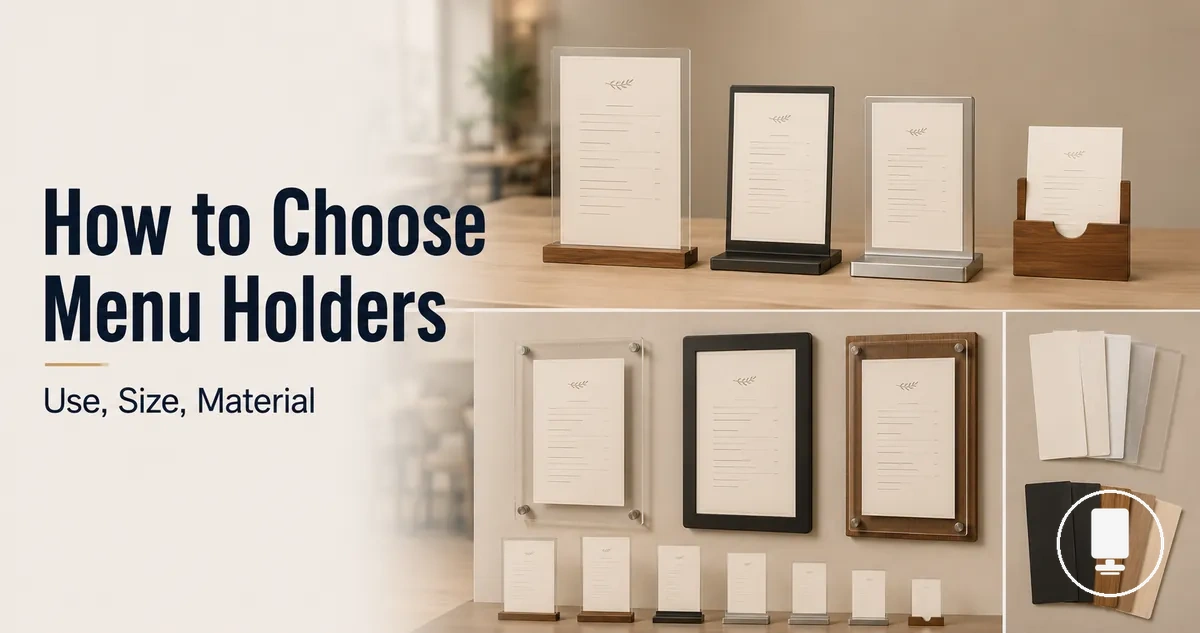
Menu holder selection guide for restaurant use, fit, and material needs
Menu holder selection depends on the restaurant use case, printed menu fit, display conditions, material durability, and cleaning needs. There is no universal right choice because restaurant menu holders work differently on a table display, counter display, reception area, or cafe service point.
A table-service restaurant may need menu holders that stay readable during guest handling, while a counter-service setting may need menu display holders that keep the insert visible from a short viewing distance. Size, material, and display formats should be checked together because a clear holder, wooden stand, or menu card holder can suit different handling and cleaning routines. For broader category context before narrowing the choice, use the menu holders guide as the main reference point.
Menu holders display printed menus, but suitability can vary by insert size, orientation, material finish, surface space, and cleaning frequency. Product examples may illustrate possible choices, but the page subject remains selection logic, not a catalog of individual products or partner offers.
What menu holder choice depends on
Selection criteria for menu holders depend on the use case, placement, menu size, visibility requirements, cleaning frequency, and durability expectations. A suitable choice is usually determined by how the menu holder will be used rather than by a single feature. Printed menu fit, insert changes, material, and handling conditions help narrow options before comparing specific formats.
The main factors behind menu holder choice can be organized visually before evaluating individual formats. The image highlights how use case, size, material, visibility, and cleaning needs influence selection priorities.
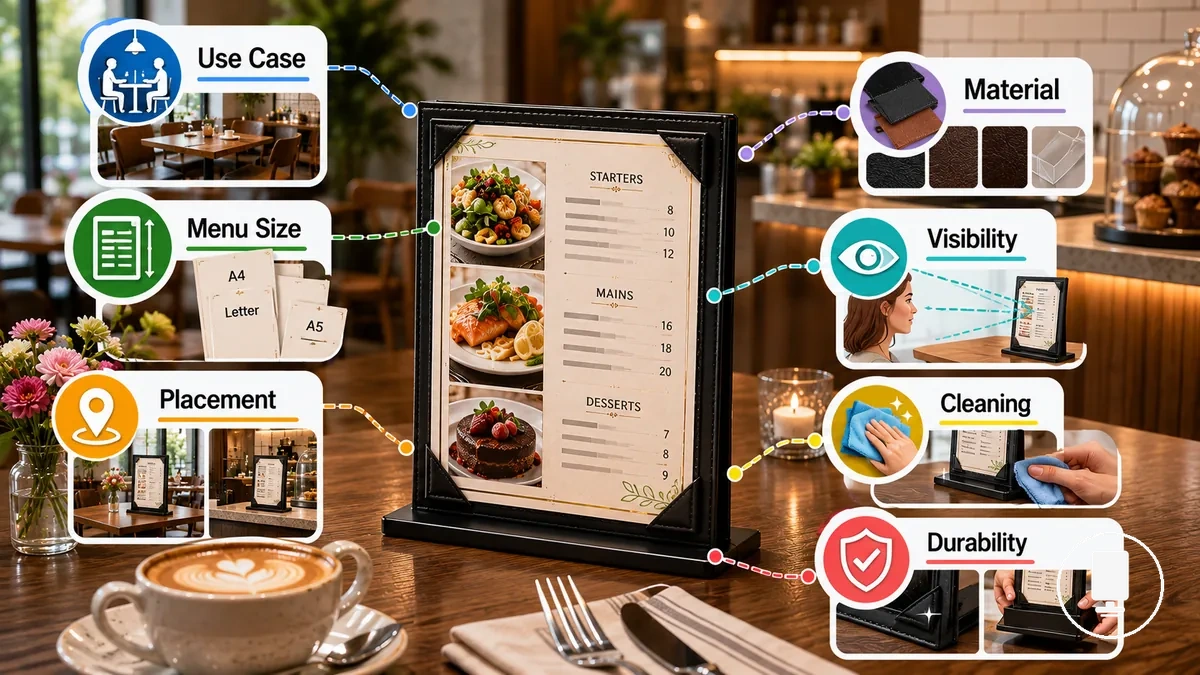
A cafe with frequent menu updates may prioritize insert changes, while a restaurant table setup may place greater emphasis on visibility and handling. A counter display may give more weight to customer access and placement conditions. Different service environments can change which decision factors matter most. For that reason, suitability depends on context rather than a fixed preference.
The checklist below groups the main selection criteria before moving into detailed sizing, material, placement, and format discussions. These suitability checks help organize decision priorities without suggesting a one-size-fits-all outcome.
- Use case: Dining, counter, reception, or promotional use can change which features deserve priority.
- Placement: Available space and display location may influence stability, access, and visibility requirements.
- Menu size: Printed menu fit should align with the intended insert dimensions because size affects presentation and usability.
- Insert changes: Frequent updates may increase the importance of easy insert replacement and handling.
- Material: Material choice can affect cleaning frequency, appearance retention, and durability expectations.
- Visibility: Customer viewing conditions may determine whether display clarity becomes a higher priority.
- Cleaning frequency: Environments with regular cleaning may benefit from materials that are easier to maintain.
- Durability: Higher handling levels may increase the importance of durability when evaluating suitability and quantity needs.
Match menu holders to the service setting
Menu holder compatibility depends on the service setting because viewing distance, customer handling, surface space, and display conditions can change holder requirements. A menu holder that suits one use environment may be less suitable in another when guest access patterns or display priorities differ. Matching menu holders to the service setting helps narrow choices before evaluating specific formats.
Matching menu holders to the service setting depends on where guests view and handle the menu. The image illustrates how table service, counter ordering, reception areas, and buffet points can create different visibility, access, and surface-space requirements.
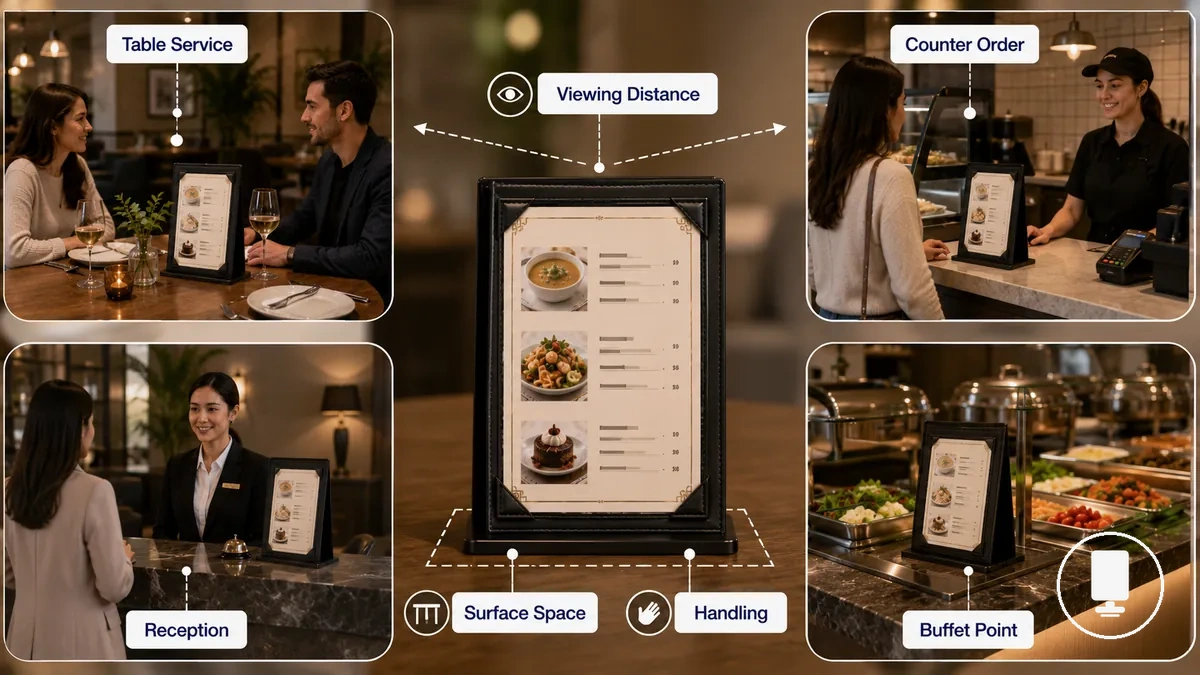
In table service environments, customer handling and available surface space often become important considerations. In counter ordering areas, viewing distance and quick access may carry greater weight. A reception area may prioritize visibility for arriving guests, while a buffet point may require consideration of movement patterns around the display. Outdoor exposure can also affect suitability when weather conditions or higher handling levels are factors.
The table below summarizes how service setting changes menu holder requirements. These compatibility cues help identify potential mismatches before moving into more detailed placement decisions.
| Service setting | Holder requirement | Risk if mismatched | Selection cue |
|---|---|---|---|
| Table service | Good visibility during customer handling | Reduced menu access or readability | Consider surface space and guest interaction |
| Counter ordering | Clear viewing from a short distance | Lower visibility during ordering | Consider viewing distance and stability |
| Reception area | Easy visibility for arriving guests | Menu information may be overlooked | Consider approach direction and access |
| Buffet point | Readable display near customer flow | Reduced menu awareness | Consider movement patterns and exposure |
A brief placement check is often enough when the main goal is matching menu holders to a service setting based on visibility, handling, and surface space. When the decision depends on display location details, placement context, or display-specific constraints, refer to menu holder placement for a more focused evaluation.
Tabletop and counter display conditions
Tabletop use depends on dining-table interaction, while counter display depends more on visibility from a standing position. Tabletop conditions often involve closer customer reach and a smaller table footprint. Counter display conditions may place greater emphasis on viewing angle and customer access.
Tabletop and counter display conditions change visibility, reach, and base stability requirements. The image compares a tabletop holder and a counter holder to show how surface height and viewing angle can influence suitability.
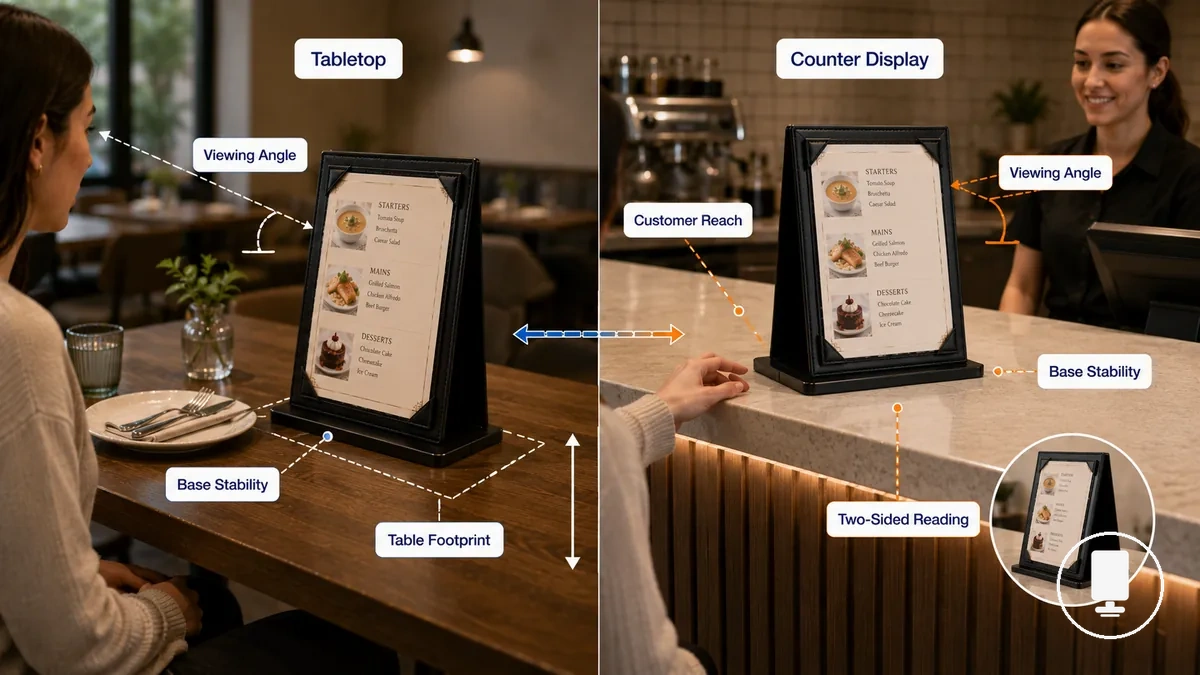
Holder choice depends on how surface height, customer reach, viewing angle, and base stability interact within the display surface. One-sided reading may suit a single viewing direction, while two-sided reading may be more suitable when customer access comes from multiple sides.
- Tabletop use may favor a compact table footprint when dining-table space is limited.
- Counter display may require a viewing angle that remains readable from the customer side.
- Frequent customer reach can increase the importance of base stability during handling.
- One-sided reading or two-sided reading depends on how customers approach and access the display.
Guest handling, visibility, and menu access
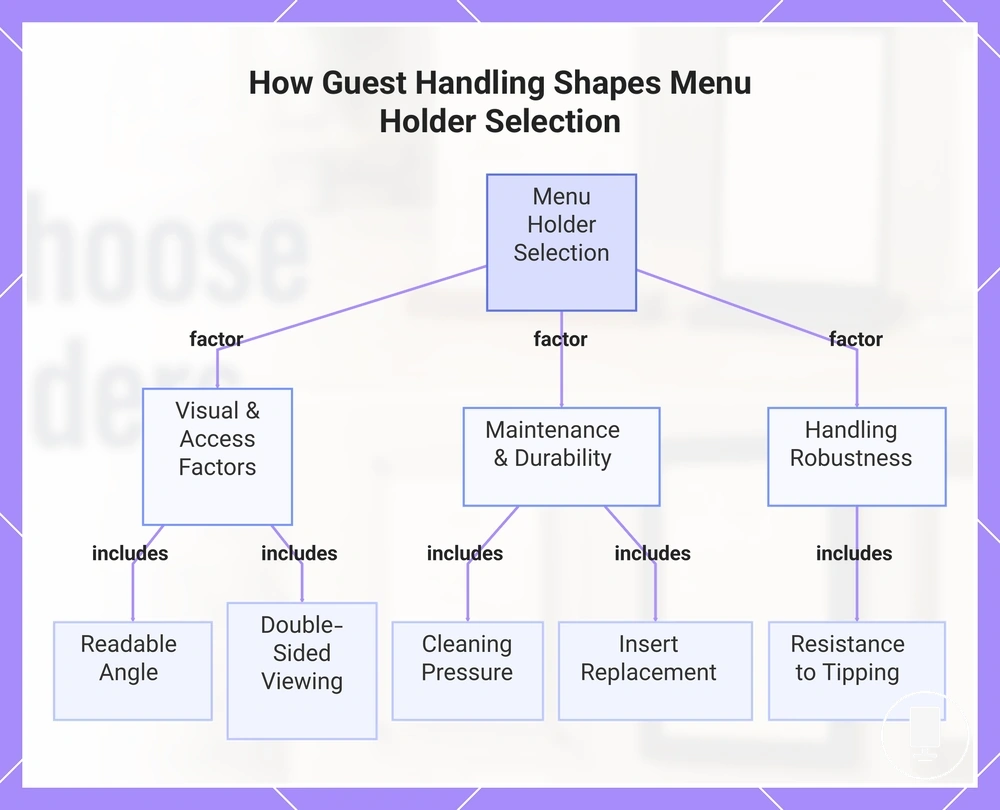
Guest handling changes the practical demands placed on a menu holder because frequent interaction can affect visibility, menu access, and day-to-day maintenance needs. A menu display holder that is touched often may face different conditions than one viewed with limited handling. Visibility and access can depend on how guests approach, read, and return the menu.
Guest interaction, visibility, and menu access create conditions that help narrow holder format choices. Cleaning pressure, insert replacement, readable angle, and resistance to tipping may become more important as handling frequency increases. Glare can affect visibility in certain lighting conditions, while double-sided viewing may be useful when menus need to be read from more than one direction. Insert size, material, and long-term use can also influence suitability.
- Frequent guest handling may increase the importance of resistance to tipping during use.
- Higher cleaning pressure can make material and surface maintenance considerations more relevant.
- A readable angle may support menu access when guests view the menu from different positions.
- Double-sided viewing may be useful when customer access occurs from multiple directions.
- Regular insert replacement can increase the value of a holder format that allows straightforward updates.
- Glare conditions may influence visibility depending on lighting and display orientation.
When guest interaction is frequent, menu holder selection often depends on balancing visibility, menu access, cleaning pressure, and handling conditions rather than prioritizing a single attribute.
This chart shows the key factors influenced by frequent guest handling that determine menu holder format choices.
Choose the right size and insert format
Choosing the right menu size and insert format depends on the printed menu dimensions, orientation, and page count. A menu holder should match the menu size closely enough for proper display, while the insert format should support how often the menu content changes. Suitability can vary based on insert thickness, holder format, and the intended display option.
Printed menu size and menu holder size work together as a selection decision rather than separate choices. Common examples such as A4, A5, and small card formats can suit different restaurant uses, but the most suitable option depends on available content, viewing needs, and update routines. Orientation also matters because portrait and landscape layouts may require different holder formats even when the printed area is similar.
The comparison below organizes common sizing and insert format choices by attribute, trade-off, and use case.
| Option | Attribute | Trade-off | Suitable use case |
|---|---|---|---|
| Small card format | Compact display area | Limited content capacity | Simple table notices or short menu items |
| A5 format | Balanced size and readability | May limit larger menu layouts | Condensed food or drink menus |
| A4 format | Larger display area | Requires more display space | Menus with broader content coverage |
| Single-sheet insert | Simple update process | Limited page capacity | Menus with stable content and low page count |
| Multi-page format | Higher content capacity | Can require more handling during use | Menus with larger page counts or category sections |
Page count, orientation, and update frequency often work as linked criteria. A single-sheet insert may be suitable when content changes are limited, while a multi-page format may suit menus that contain more sections. Portrait and landscape layouts should be evaluated according to how the printed menu fits within the holder format.
When sizing decisions require a closer comparison of common formats and insert layouts, reviewing menu holder sizes can provide additional context before choosing a final menu holder format.
Single page, double sided, and multi page formats
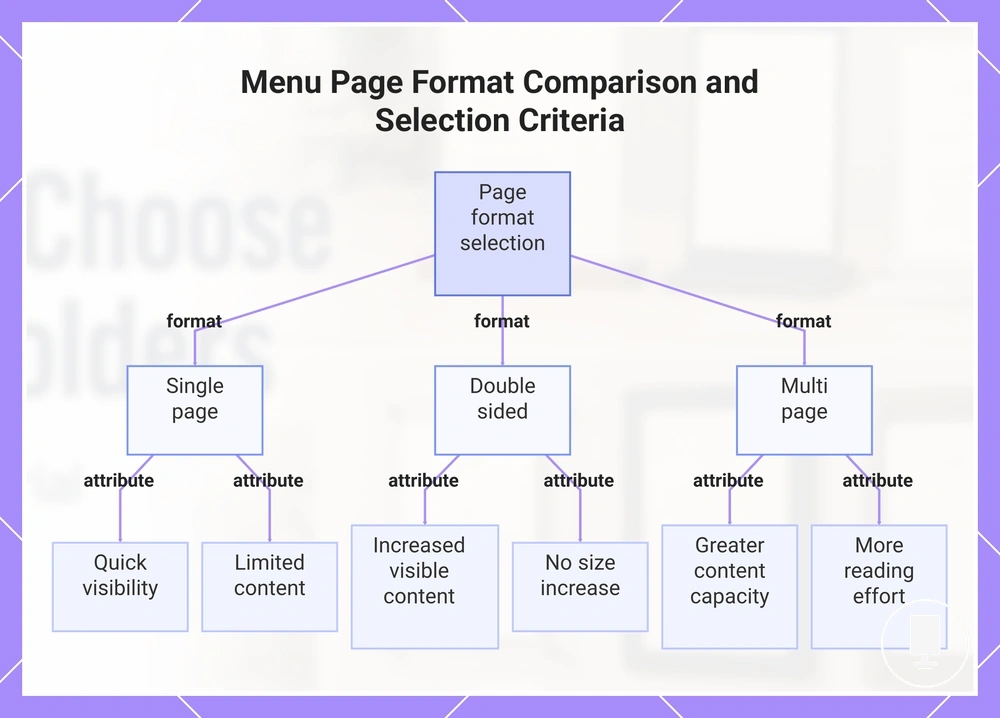
Page format selection criteria depend on how page count affects visibility, handling, and insert replacement. Single page, double sided, and multi page formats present information differently, which can influence menu access and reading effort. The most suitable choice depends on the use case, size requirements, material considerations, and holder format.
Page format differences become clearer when comparing the conditions each format is intended to support. The checklist below highlights the main trade-offs that affect suitability and selection criteria.
- Single page: Supports quick visibility and may suit specials, limited menus, or short content displays.
- Double sided: Increases visible content without increasing display size and may suit table displays viewed from more than one direction.
- Multi page: Provides greater content capacity but can require more reading effort and handling during use.
- Folded or booklet-style menus: Can organize more content within a compact format, though handling may increase during reading.
- Insert replacement: Single-page and double-sided formats may simplify updates when content changes frequently.
- Use case: Higher page count may support broader menu coverage, while shorter menus may not require additional pages.
- Material and durability: Material choice and handling frequency can influence long-term suitability regardless of page format.
When comparing page formats, the decision often depends on balancing visibility, handling, page count, and replacement needs rather than focusing on content capacity alone. This criteria-based approach can help match a menu holder to the intended restaurant use.
This chart compares the key attributes of single-page, double-sided, and multi-page menu formats to aid in format selection.
Printed menu dimensions and orientation fit
Printed menu dimensions and orientation fit depend on matching the menu size, insert format, and holder opening before purchase. Fit issues often result from differences in size, orientation, insert thickness, or page count rather than from the menu holder category itself. Checking these conditions together can reduce the risk of selecting an unsuitable holder format.
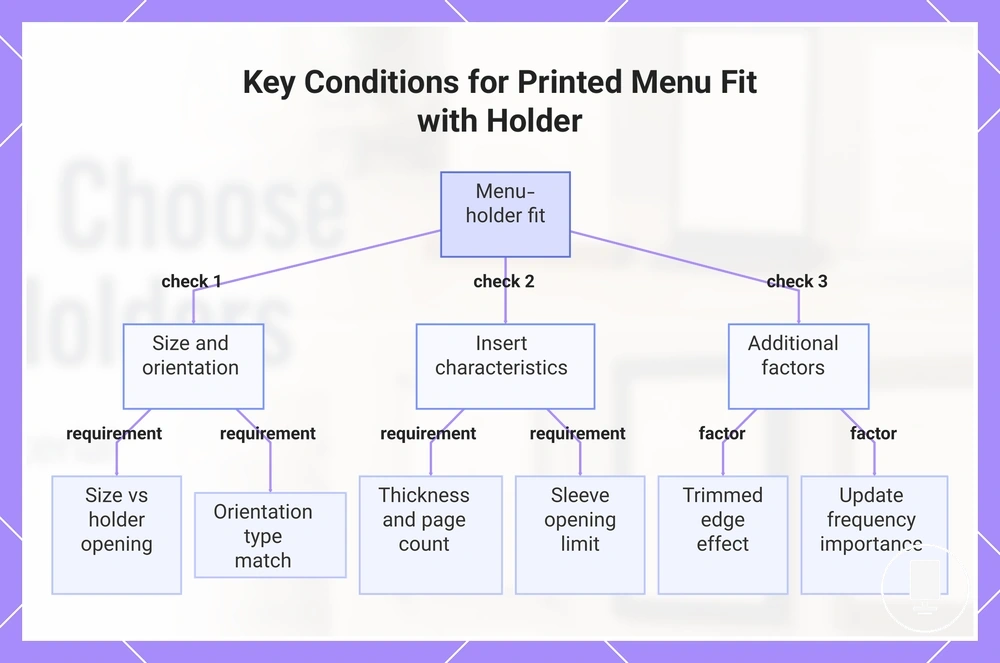
Printed menu dimensions and orientation fit should be verified before comparing materials or display options. The checklist below highlights the conditions most likely to affect suitability.
- Menu size: Printed menu dimensions should be compared with the holder opening because size differences may limit fit.
- Orientation: Portrait orientation and landscape orientation should match the intended insert format to reduce mismatch risk.
- Height and width: Both dimensions should be checked because a match in only one direction may still create fit issues.
- Insert thickness: Thicker inserts or higher page count may affect how comfortably the menu fits within the holder.
- Sleeve opening: Holder openings can limit suitability even when the stated menu size appears compatible.
- Trimming: Trimmed menu edges may change final dimensions and can affect fit if not verified beforehand.
- Insert-change frequency: Frequent updates may increase the importance of a holder format that allows straightforward insert replacement.
When menu size, orientation, holder opening, and insert conditions are checked together, the selection decision becomes more reliable and helps identify potential fit problems before purchase.
This chart shows the main conditions to verify when matching printed menu dimensions and orientation to a menu holder.
Select materials by durability, clarity, and cleaning needs
In a restaurant with frequent handling and regular surface cleaning, material choice can affect how a menu holder maintains visibility, appearance, and day-to-day usability. In a presentation-focused setting, the preferred material may depend more on finish, weight, and perceived style. Material selection is therefore a decision about durability, clarity, cleaning needs, and presentation priorities rather than appearance alone.
Menu holder materials differ in how they balance transparency, cleaning behavior, scratch visibility, and handling conditions. Acrylic and clear plastic materials may support high clarity when visibility is a priority, while wood, metal, and leather-look finishes may emphasize presentation and surface character. Durability, wipe-clean behavior, and long-term suitability can vary by material, finish, and restaurant use conditions.
The comparison below organizes common material choices by attribute, trade-off, and suitability.
| Option | Attribute | Trade-off | Suitable use case |
|---|---|---|---|
| Acrylic | High clarity and transparent presentation | Scratch visibility may become more noticeable depending on use | Displays where menu visibility is a priority |
| Plastic | Lightweight display option | Appearance and durability can vary by material type | General restaurant use with regular insert changes |
| PVC | Flexible holder format options | Clarity and finish may vary by construction | Menus that require frequent handling |
| Wood | Natural finish and heavier presentation | Transparency is not available | Settings that emphasize visual character |
| Metal | Structured appearance and weight | Visibility depends on holder design rather than transparency | Display areas with a more substantial presentation style |
| Leather-look finish | Decorative finish and menu presentation focus | Cleaning and wear characteristics may vary by surface finish | Presentation-oriented restaurant environments |
When cleaning frequency is high, wipe-clean behavior and surface condition may deserve more attention. When presentation is the primary goal, finish, weight, and visual style may carry greater influence in the decision. For a deeper evaluation of individual material characteristics, compare menu holder materials.
Clear acrylic, plastic, and PVC suitability
In settings where menu visibility and regular cleaning are priorities, clear acrylic, plastic, and PVC holders may suit the material decision because they keep inserts visible while supporting straightforward surface maintenance. Their suitability depends on clarity, finish, durability, and handling conditions rather than transparency alone. Differences in weight, scratch visibility, and edge wear can influence which display option fits a table or counter environment.
Clear acrylic holders often emphasize clarity and insert visibility, but scratch visibility may become more noticeable depending on finish and use conditions. Clear plastic holders are typically lightweight, which may suit menu display holder formats that are moved or updated frequently. PVC holders can support easy wiping in many cases, though durability, edge wear, and long-term appearance may vary by material construction and cleaning routines.
- Clear acrylic may suit displays where insert visibility and presentation clarity are priorities.
- Clear plastic may suit restaurant use that benefits from a lighter holder format.
- PVC may suit environments with regular cleaning and frequent menu handling.
- Scratch visibility can vary by material, finish, and day-to-day use conditions.
- Table or counter suitability depends on weight, handling patterns, and cleaning requirements.
When comparing clear materials, the decision is usually based on balancing clarity, cleaning needs, durability expectations, and display conditions rather than assuming all transparent menu holders perform the same way.
Wood, metal, leather-look, and premium finish suitability
In restaurants where presentation, handling stability, and long-term appearance matter, wood, metal, leather-look, and premium-looking materials may support the menu holder decision. These materials often involve a trade-off between finish, visibility, cleaning needs, and durability. Suitability depends on the material condition, handling patterns, and the restaurant environment.
Wood menu holders may suit settings where a heavier material and distinctive finish support presentation goals, though moisture exposure and cleaning routines can influence long-term durability. Metal holders can provide added weight and stability for table or counter use, but insert visibility depends on the holder format rather than material clarity. Leather-look finishes may support a presentation-focused display option, though wipe-clean limits, surface wear, and durability can vary by finish and use conditions.
- Wood may suit environments where presentation and stability are prioritized over insert visibility.
- Metal may suit tables or counters that benefit from additional weight during handling.
- Leather-look finishes may suit menu display holder formats where finish and presentation influence the selection decision.
- Cleaning requirements, moisture exposure, and surface wear can affect long-term suitability.
- Insert visibility may be more limited than with transparent materials, depending on the holder design.
When evaluating premium-looking materials, the decision usually depends on balancing presentation goals, cleaning needs, durability expectations, and visibility requirements rather than focusing on finish alone.
Balance restaurant style with practical presentation
Menu holder selection depends on balancing restaurant style with practical presentation so the display supports both appearance and everyday usability. A holder format that suits the dining environment may be less suitable if visibility, readability, or cleaning needs are reduced. The goal is to choose a display option that supports restaurant use while maintaining clear menu access.
Restaurant style can influence material, holder color, transparency, and finish choices, but these attributes are most effective when they support readability under normal restaurant lighting. A menu holder that aligns with table design and guest expectations may still require sufficient menu visibility and practical cleaning routines. Transparency, finish, and display conditions should work together rather than competing with usability.
The decision matrix below organizes common style-versus-usability trade-offs during menu holder selection.
| Selection factor | Supports usability when | May be less suitable when |
|---|---|---|
| Holder color | Menu content remains easy to read | Color reduces visibility or contrast |
| Transparency | Insert visibility is a priority | Glare or display conditions affect readability |
| Premium finish | Presentation aligns with restaurant use and cleaning routines | Maintenance practicality becomes more difficult |
| Display stability | Handling conditions support steady menu presentation | Style choices reduce stability during restaurant use |
When style and practicality compete, menu holder selection is usually stronger when visibility, readability, stability, and cleaning needs remain the deciding criteria. This approach helps maintain a display that supports guest expectations while remaining practical for long-term restaurant use.
Compare format trade-offs before choosing
Format trade-offs matter because no menu holder format is most suitable in isolation. Freestanding holders, table tents, insert holders, clip-style holders, counter displays, double-sided formats, and multi-page formats each balance visibility, stability, footprint, insert changes, and long-term use differently. The right decision depends on which condition matters most in the restaurant use case.
Visibility affects how easily guests notice and read the menu. Stability affects how well the holder may tolerate handling or movement. Footprint affects how much table space or counter space the format uses. Insert changes affect how practical the holder remains when menus are updated often.
The comparison below organizes common holder formats by their main strength, trade-off, and suitable use case. For a deeper format-level breakdown, compare menu holder types before narrowing the final display option.
| Format | Main strength | Trade-off | Best use case |
|---|---|---|---|
| Freestanding holders | Visible upright display | May need more footprint and stable surface space | Tables, counters, or reception points where visibility matters |
| Table tents | Two-sided visibility | Limited insert capacity | Table displays viewed from more than one side |
| Insert holders | Simple menu replacement | Suitability depends on insert size and opening | Menus that change regularly |
| Clip-style holders | Quick insert changes | May offer less coverage for the printed menu | Temporary menus, specials, or short notices |
| Counter displays | Clear access from ordering areas | Viewing distance and stability need checking | Service counters and ordering points |
| Double-sided formats | More visible sides without extra table footprint | Content space is still limited by insert size | Shared table or counter viewing |
| Multi-page formats | Higher content capacity | Can increase handling and reading effort | Larger menus with more sections |
Long-term use depends on how often menus change, how much handling the holder receives, and whether the format remains practical to clean and replace. A format with strong visibility may be less suitable if it takes too much table space, while a compact format may be less suitable when page count or readability matters more.
Choose the holder format that fits the main condition first, then compare value only after visibility, stability, footprint, and insert changes are clear. If the decision depends on cost, quantity, or long-term replacement logic, review menu holder price and value after the format trade-offs are settled.
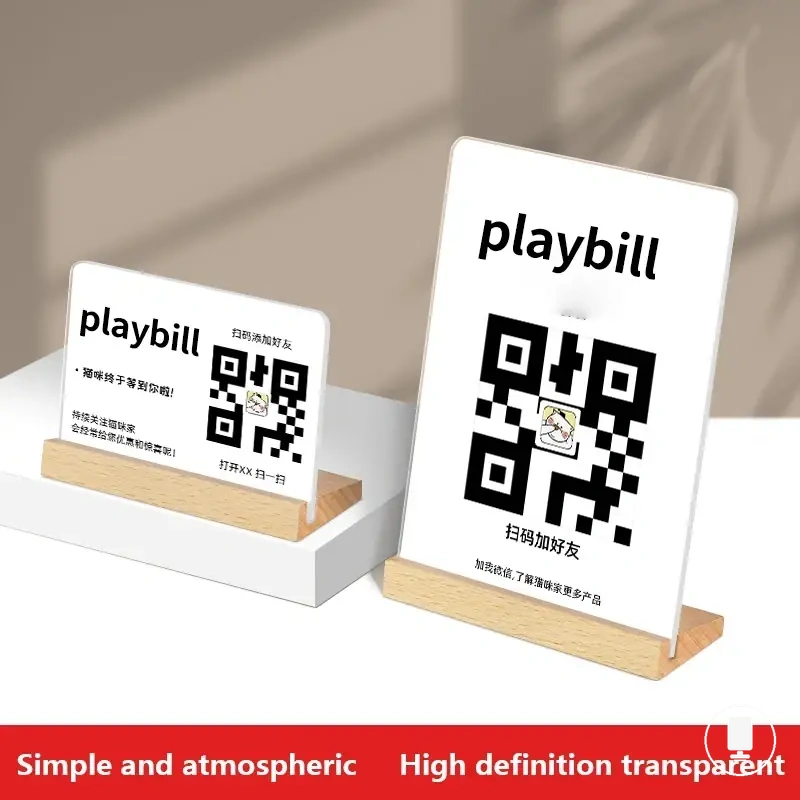
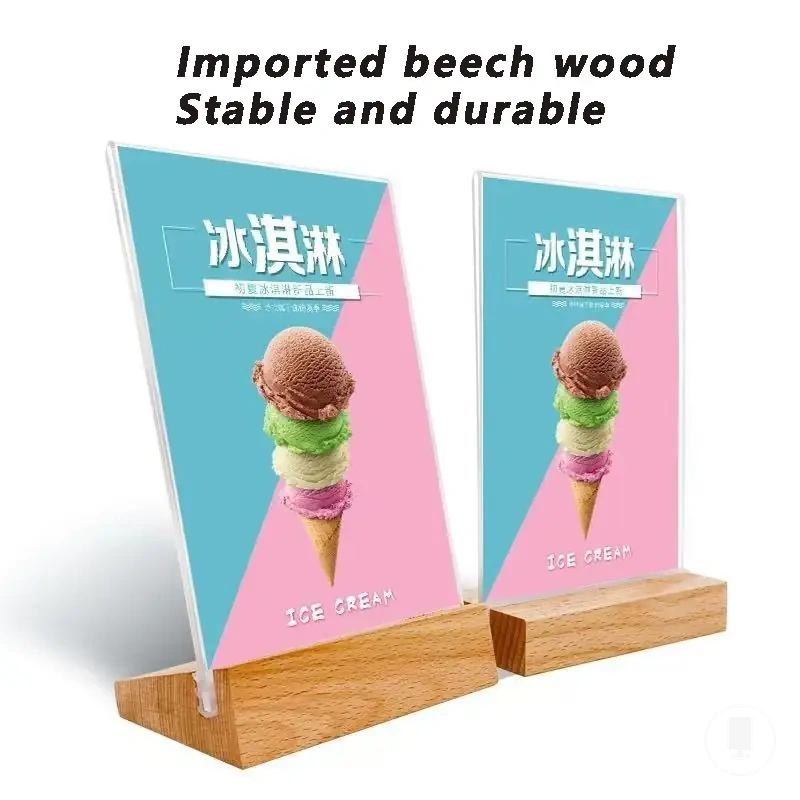
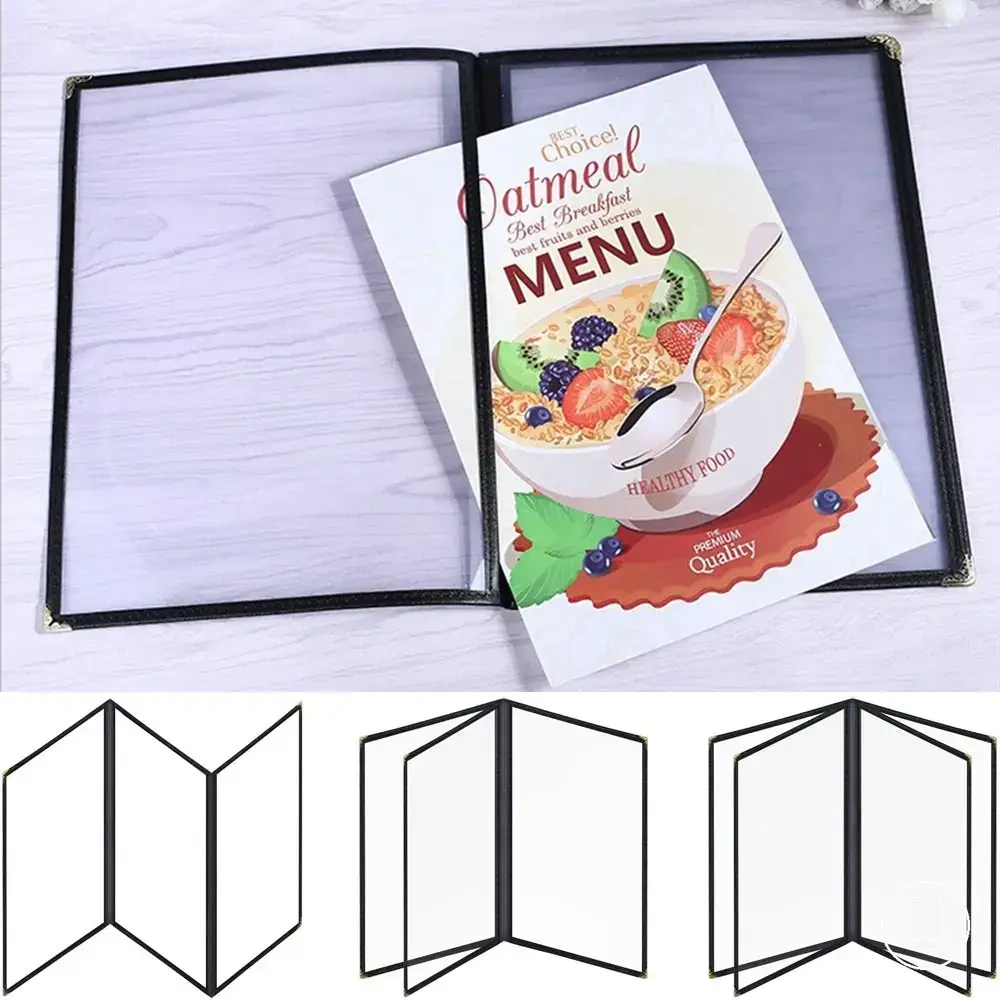
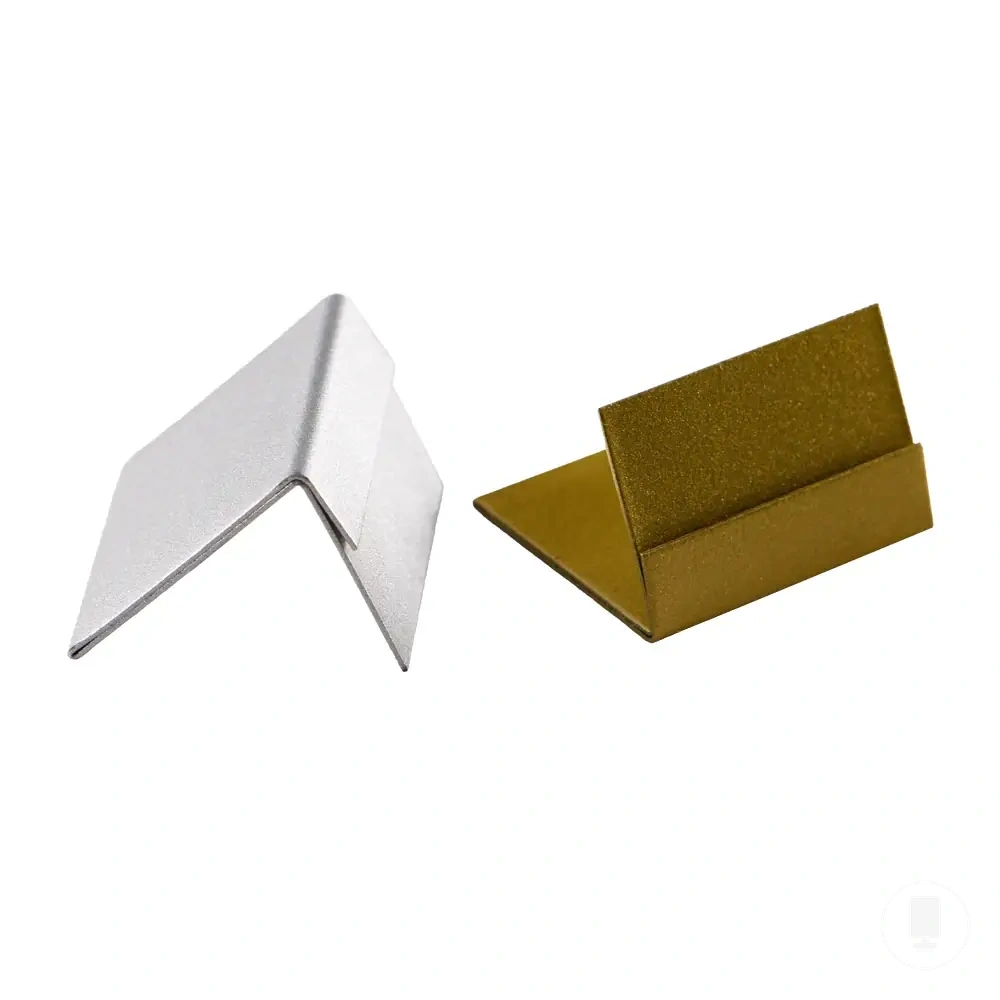
The products below are useful examples for comparing available options. Before buying, check that the compatibility criteria, key features, and product details match your needs.

Stability, footprint, and table space
Stability, footprint, and table space affect format suitability because a menu holder must stay practical within the available service area. Base width, weight, menu height, size, and material can change how well a holder format fits the use case. These selection criteria help filter formats before comparing appearance or long-term durability.
Physical space limits can make a stable-looking display option less suitable in crowded table layouts or on narrow counters. A taller menu stand may improve visibility in some restaurant use cases, but it may also increase tipping risk if the base design, holder weight, or surface conditions do not support it. Outdoor movement, guest handling, and blocked service space should be considered as conditions, not exact guarantees.
- Base design: A wider or heavier base may improve stability, but it can also increase footprint.
- Crowded tables: Limited table space may favor a compact holder format that does not block plates, drinks, or service flow.
- Narrow counters: Counter displays may need a smaller footprint when ordering space is limited.
- Menu height: Taller displays may improve visibility, but suitability depends on base stability and handling conditions.
- Outdoor movement: Air movement or uneven surfaces can increase tipping risk depending on material, weight, and base design.
- Blocked service space: A format may be less suitable when it limits access to the table, counter, or menu insert.
When stability and footprint compete, the better decision is usually the format that keeps the menu visible while leaving enough table space for normal restaurant use.
Menu changes, replaceable inserts, and long-term use
Menu update frequency affects the long-term value of a holder format because replaceable inserts can reduce handling effort when content changes regularly. Seasonal menus, daily specials, and routine updates may make insert replacement more relevant than appearance alone. Long-term use depends on how the format supports menu changes under normal restaurant conditions.
Replaceable inserts and holder construction influence how practical a menu display holder remains over time. Staff handling, cleaning routines, sleeve durability, material condition, and insert size can affect wear and overall suitability. The checklist below highlights conditions that may influence the decision.
- Seasonal menus: Frequent content changes may favor a holder format designed for straightforward insert replacement.
- Daily specials: Regular menu updates can increase the importance of accessible replaceable inserts.
- Sleeve durability: Long-term suitability may depend on how sleeves respond to repeated insert changes and handling.
- Staff handling: Higher handling levels can increase wear depending on material and holder design.
- Cleaning wear: Repeated cleaning may influence long-term appearance and usability.
- Repair-versus-replacement practicality: A display option may be more suitable when routine maintenance remains straightforward.
When menu changes are frequent, the stronger selection decision is often the holder format that balances replaceable inserts, wear resistance, and practical long-term use without adding unnecessary handling effort.
Check durability and cleanability before purchase
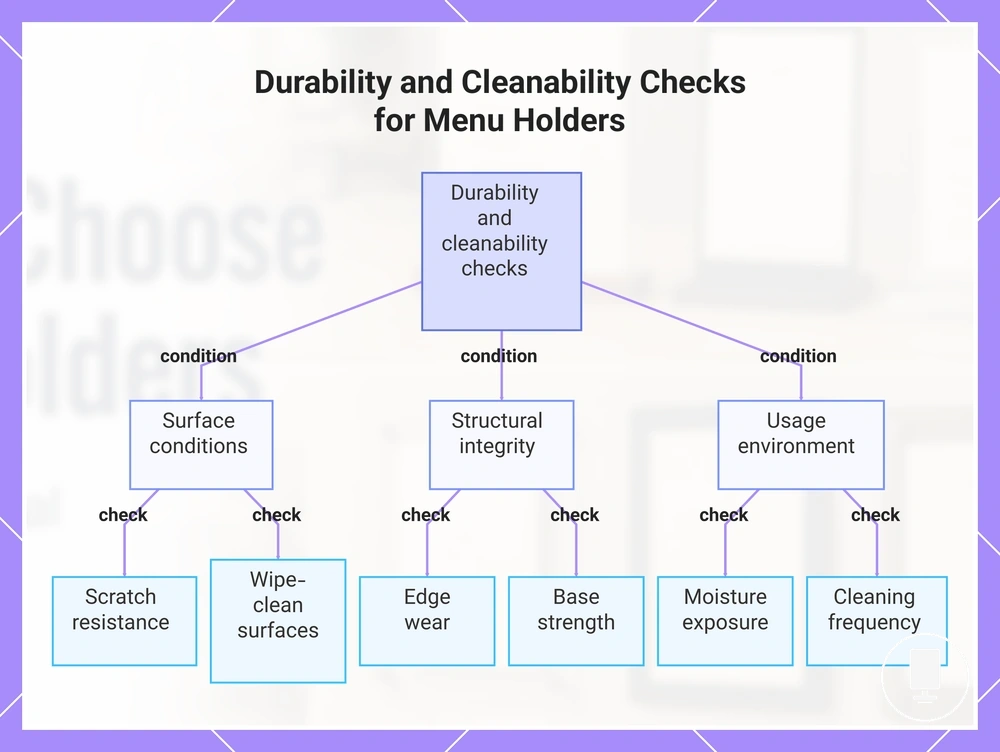
Durability and cleanability should be verified after material and format have been narrowed because these checks help confirm whether a menu holder suits the intended restaurant use. A menu display holder that appears suitable in size and style may perform differently under regular handling and cleaning conditions. These selection criteria help qualify long-term suitability before a final decision.
Durability and cleanability checks focus on how the material, construction, and use case interact under realistic service conditions. A high-use restaurant may place greater emphasis on handling, cleaning frequency, and edge wear, while a low-touch display area may place less stress on the holder format. The checklist below highlights practical conditions that can affect durability and suitability.
- Scratch resistance signals: Surface condition may affect visibility and appearance when the menu holder receives frequent handling.
- Wipe-clean surfaces: Cleaning effort can vary by material, finish, and exposure to daily restaurant use.
- Moisture exposure: Durability may depend on how the display option is used in areas exposed to spills, humidity, or regular cleaning.
- Edge wear: Repeated insert changes and handling can influence long-term condition around edges and openings.
- Base strength: A stronger base design may support stability, but suitability still depends on service conditions and holder size.
- Insert access: Easier insert access may reduce handling effort when menus require updates.
- Cleaning frequency: More frequent cleaning can increase wear depending on material and finish characteristics.
When durability and cleanability checks align with the expected use case, the final decision is more likely to reflect real service conditions rather than appearance alone.
This chart groups the key durability and cleanability checks into surface, structural, and usage categories to help qualify long-term suitability.
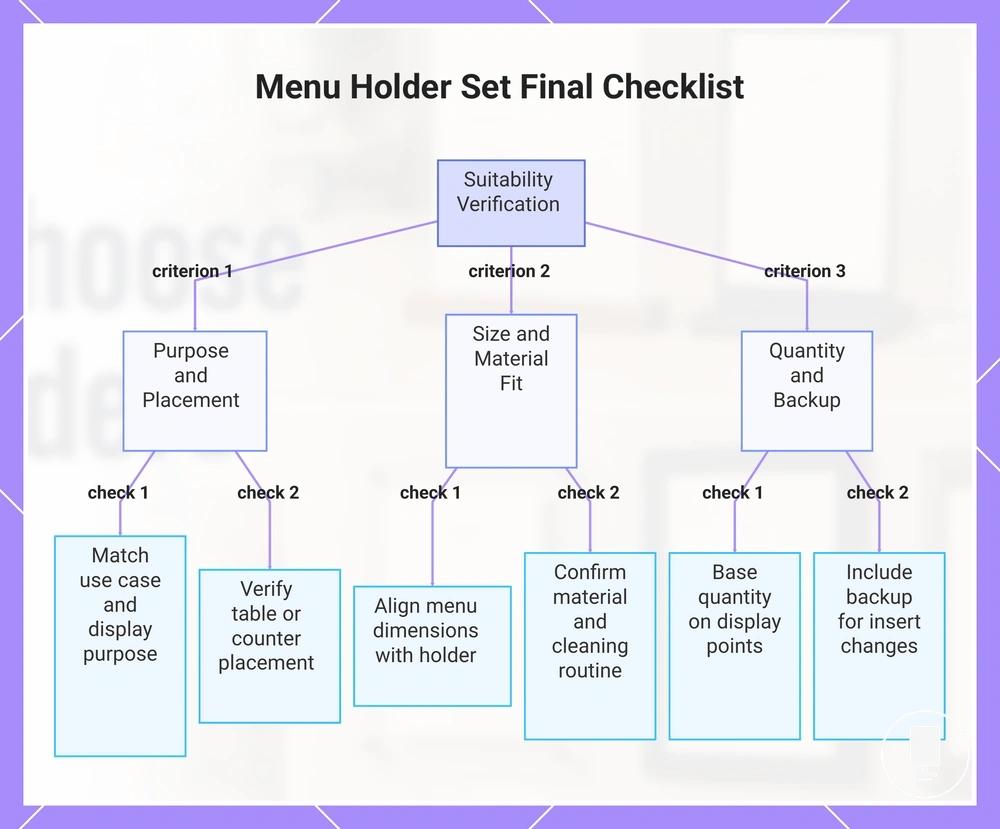
Selection checklist for a suitable menu holder set
A final checklist helps verify whether a menu holder set matches the intended use case before the selection is completed. The goal is to confirm suitability across size, material, placement, quantity, cleanability, and long-term fit rather than focusing on a single attribute. This final checklist consolidates the earlier selection criteria into a practical decision.
Use case, size, material, and placement should work together within the same holder set. Matching formats can help maintain a consistent presentation across display points, while material consistency may support a more uniform cleaning routine. Placement conditions also matter because table displays and counter displays can create different visibility and handling requirements.
Quantity decisions depend on table count, display points, and whether backup quantity may be needed for insert changes or replacement planning. When a restaurant uses multiple seating areas or mixed display locations, table count can affect menu holder set suitability. Restaurants managing multiple display points may also benefit from reviewing choose menu holders for multiple tables before finalizing the decision.
The checklist below verifies whether the menu holder set aligns with the intended restaurant environment and long-term fit requirements.
- Use case: Confirm the holder set matches the primary restaurant use and display purpose.
- Size: Verify menu dimensions align with the selected holder format.
- Matching formats: Check whether display points use compatible holder formats where consistency is preferred.
- Material consistency: Confirm materials support the intended presentation and cleanability expectations.
- Placement: Verify suitability for table needs, counter needs, or mixed display locations.
- Table count: Check whether the planned quantity reflects the actual number of display points.
- Backup quantity: Consider whether spare holders may be useful when insert changes or replacements occur.
- Insert changes: Confirm the holder format supports the expected update routine.
- Cleaning routine: Verify the material and format suit the expected cleaning frequency.
When the menu holder set satisfies these checks, the final decision is more likely to reflect quantity fit, presentation consistency, and long-term suitability. In multi-table or mixed display environments, suitability often depends on balancing table count, display points, matching formats, and backup quantity rather than relying on a fixed holder quantity.
The products below are useful examples for comparing available options. Before buying, check that the compatibility criteria, key features, and product details match your needs.
This chart shows the three main verification criteria for selecting a suitable menu holder set.