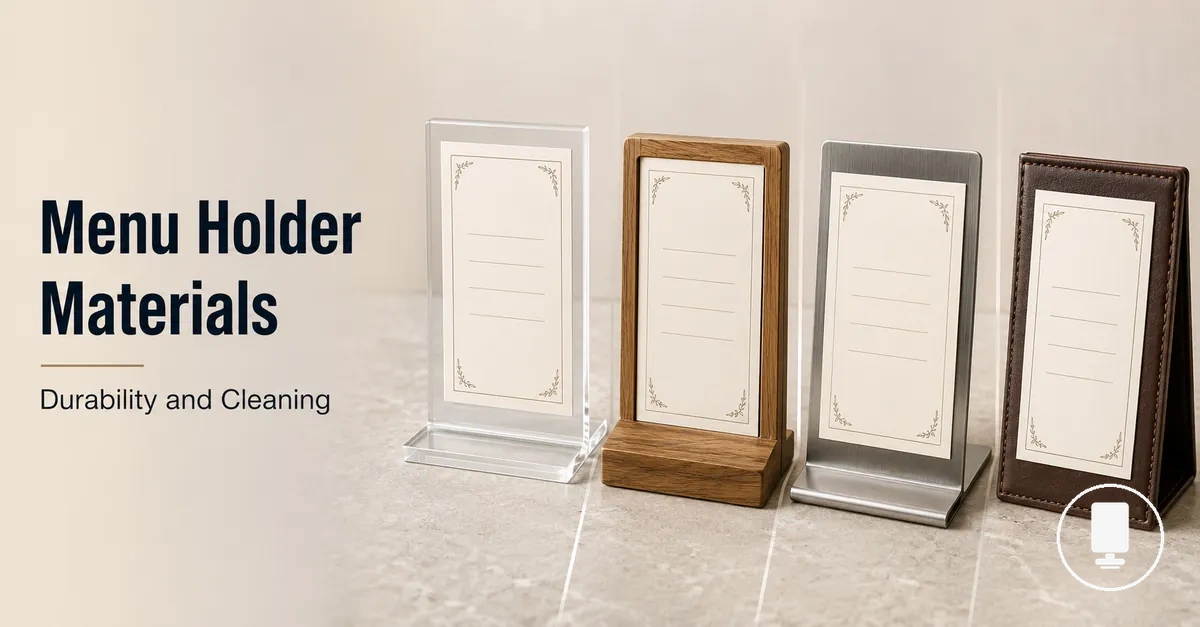
Menu holder materials for durability and cleanability
Menu holder materials are the surface and construction choices that affect how a menu display holder looks, handles, cleans, and wears during restaurant use. Material does not only change appearance; it also changes the balance between durability, cleanability, and replacement risk. For this page, material is the main decision variable.
Durability and cleanability are related, but they are not the same outcome. A material may resist dents or bending while still showing scratches, residue, or moisture marks. Another material may wipe-clean quickly but depend more on thickness, finish, or handling quality for longer service. The practical choice is usually a trade-off between surface care and wear resistance.
Acrylic, wood, metal, leather-look, and PVC each support different restaurant use conditions. Acrylic gives a clear surface for visibility but may show scratches; wood can support warmer presentation when the finish is suitable; metal can add weight but may need attention to dents or corrosion resistance. Leather-look and PVC can support wipe-clean service in many cases, but coating, flexibility, clear plastic quality, and clouding risk can change the outcome, so no material is a universal winner.
The useful comparison starts by matching material behavior to cleaning effort, service setting, appearance, and likely replacement risk. High-contact tables often need smoother surfaces and lower cleaning friction, while presentation-led settings may accept more care if the finish supports the dining style. The first major material-performance context is how each surface behaves under daily handling.
| Material | Decision strength | Main condition to check |
|---|---|---|
| Acrylic | Clear visibility and wipe-clean surface | Scratch visibility and surface thickness |
| Wood | Warm presentation and solid feel | Finish quality and moisture exposure |
| Metal | Weight, rigidity, and stable handling | Dents, edge finish, and corrosion resistance |
| Leather-look | Formal appearance with coated surface behavior | Edge wear, seams, and stain response |
| PVC | Flexible clear plastic protection | Clouding, bending, and replacement risk |
What menu holder material changes in daily restaurant use
Menu holder material is the surface and construction layer that changes how a holder feels, stands, cleans, and wears during daily use. It affects build quality through weight, clarity, grip, surface behavior, and the way the holder responds to repeated handling. These material traits connect directly to material performance in restaurant settings.
What menu holder material changes in daily restaurant use is easiest to see through handling, visibility, and surface behavior.
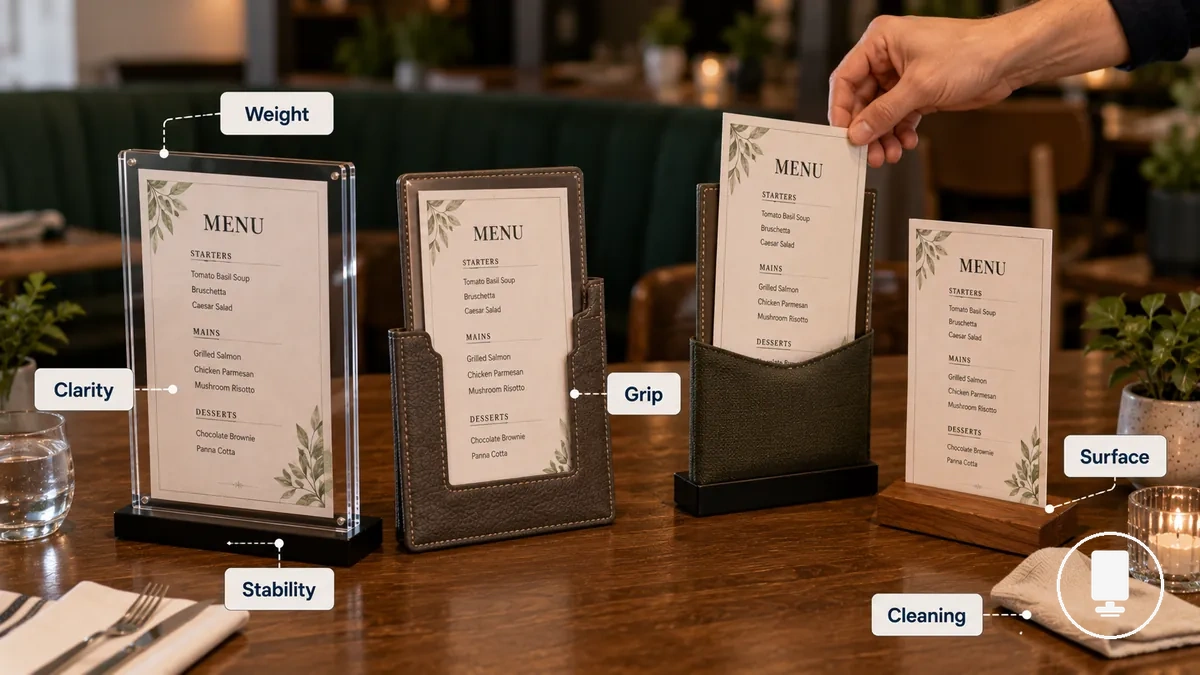
A broader menu holders guide defines the category, while menu holder material explains how the holder behaves during use. Material affects weight, surface feel, cleaning effort, and grip, which can influence stability on a restaurant table or counter display. Stain resistance, scratch risk, moisture tolerance, and cleaning speed may vary based on construction, finish, and handling frequency. These effects should be compared within the service setting rather than by material name alone.
Material and type serve different roles in comparison. A table stand, counter display, or insert format describes how a menu holder is used, while menu holder material affects durability, surface behavior, and handling outcomes. Keeping this distinction clear helps ground later material comparisons without turning the section into a type guide.
Acrylic, wood, metal, leather-look, and PVC menu holder materials
Acrylic, wood, metal, leather-look, and PVC menu holder materials compare differently because visibility, cleaning effort, weight, and presentation do not point to the same material choice. Each material family offers distinct material strengths and limitations that may suit different restaurant conditions, so no material should be treated as a universal choice.
Acrylic, wood, metal, leather-look, and PVC menu holder materials are easiest to compare when the same criteria are applied across all options. The image below compares visible material surfaces before the table summarizes cleaning fit, presentation effect, and common trade-offs. Material comparison should remain separate from format selection; for structure and display formats, see menu holder types.
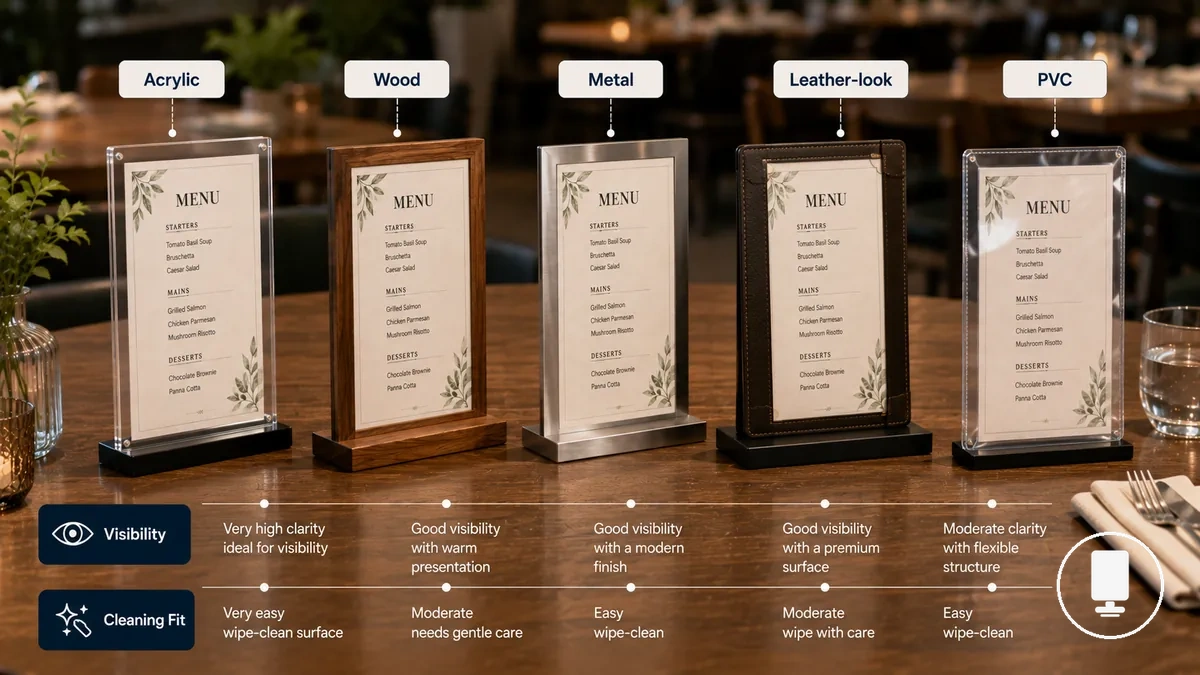
| Material | Main strength | Main limitation | Cleaning fit | Best use case |
|---|---|---|---|---|
| Acrylic | Transparency and clear menu visibility | Scratches may become noticeable | Often suits wipe-clean routines | Settings where menu visibility is important |
| Wood | Presentation supported by finish and texture | Moisture response may depend on finish | Cleaning approach depends on surface treatment | Restaurants emphasizing presentation |
| Metal | Stable feel from weight and construction | Dents or corrosion may affect appearance | Usually compatible with routine surface cleaning | Busy service areas needing stability |
| Leather-look | Formal look with covered surfaces | Coating and edge wear may develop over time | Can support regular wipe-clean handling | Menus where appearance is a priority |
| PVC or clear plastic | Flexibility and lightweight handling | Clouding may affect visibility | Often easy to clean when surfaces remain clear | Frequent menu replacement situations |
Acrylic menu holders and PVC menu holders are often compared because both can provide a clear holder appearance, yet transparency and flexibility create different trade-offs. Wooden menu holders and leather-look menu holders may support presentation-focused settings in different ways, while metal menu holders emphasize weight and stability rather than surface transparency. The most suitable outcome usually depends on service setting, handling frequency, cleaning routines, and the visual role of the menu. The following material-specific sections examine these differences in greater detail.
Acrylic menu holders
Acrylic menu holders use a rigid plastic construction with a clear surface that emphasizes transparency and table visibility. Acrylic menu holders show menu content clearly, support a wipe-clean surface, and help maintain menu visibility in table display settings. This combination of transparency and rigidity makes acrylic menu holders suitable when visibility is a primary requirement.
Acrylic menu holders are easiest to understand when their surface behavior is viewed directly. The image below clarifies transparency, surface visibility, and the appearance of the inserted menu card.
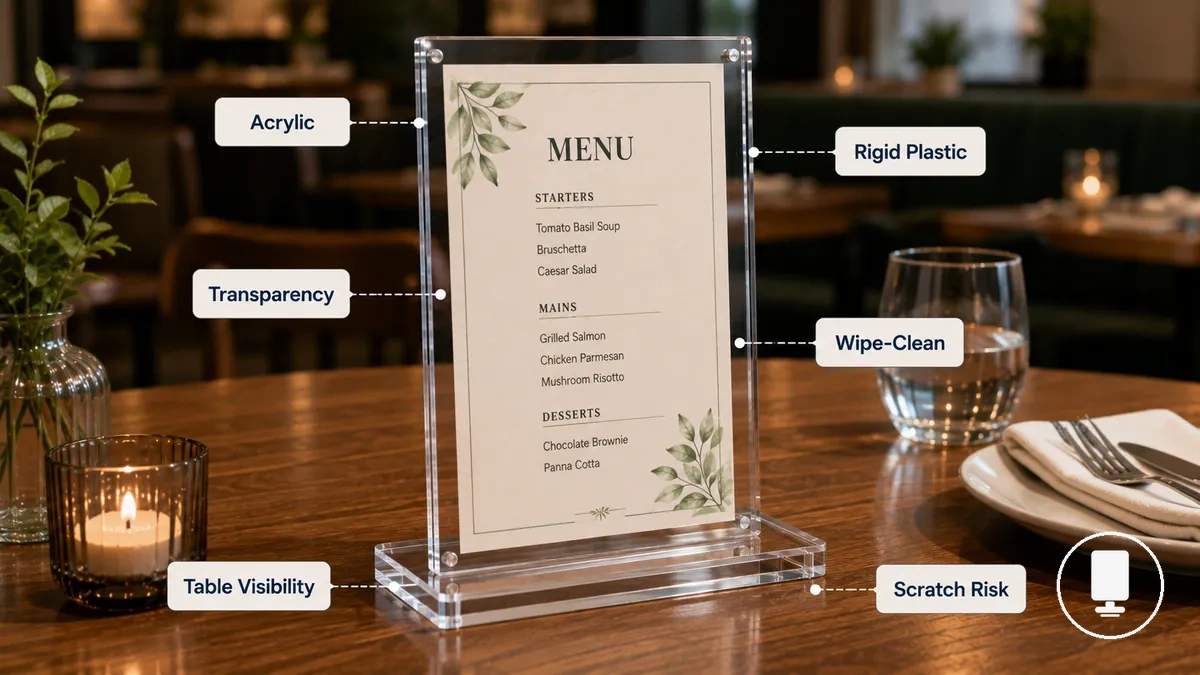
Acrylic menu holders typically allow smudges to be cleaned from the surface with routine wipe-clean care. The rigid plastic construction can support stability in table display settings when handling remains moderate. In high-touch environments or where menus are moved frequently, scratch risk may become more noticeable because scratches can be easier to see on transparent surfaces. Long-term clarity may depend on handling conditions, so scratch visibility should be considered alongside cleaning convenience.
Wooden menu holders
Wooden menu holders add visual warmth through their finish, surface texture, and natural appearance. Wooden menu holders can support a presentation-led service style while providing a solid feel during handling. Their material behavior depends largely on the finish, which influences durability, cleaning, and exposure to moisture.
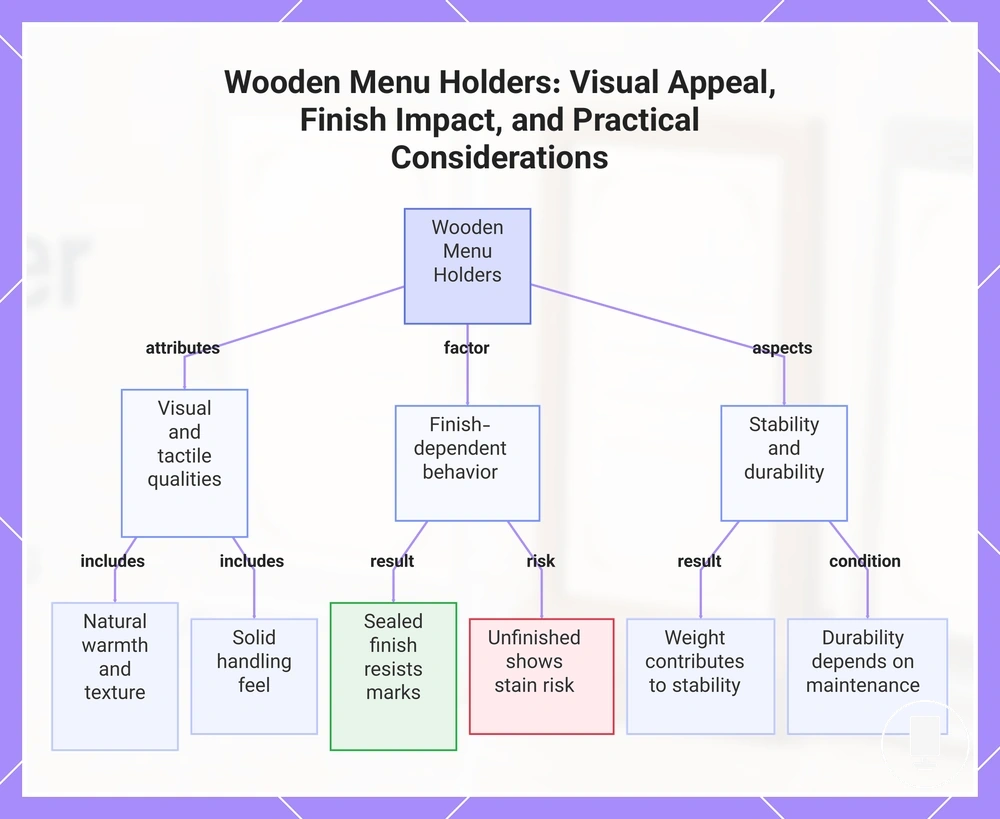
Wooden menu holders may vary in cleaning effort because surface coatings, texture, and construction can affect how the material responds to routine use. A sealed finish can help the surface resist marks more effectively, while unfinished or lightly protected surfaces may show stain risk more readily when exposed to spills or frequent handling. Weight can contribute to stability during handling, but durability may depend on finish quality and maintenance conditions. Moisture sensitivity remains a practical limitation because prolonged exposure to liquids may affect the finish or surface over time.
This chart shows the main attributes of wooden menu holders, including their visual and tactile qualities, how the finish affects durability and stain resistance, and practical considerations like weight stability and moisture sensitivity.
Metal menu holders
Metal menu holders use a rigid construction that emphasizes stability, weight, and finish-driven material behavior. Metal menu holders often provide a solid feel during handling and can help stabilize menu displays in busy service settings. Their durability, cleaning response, and long-term appearance depend largely on the finish and surface condition.
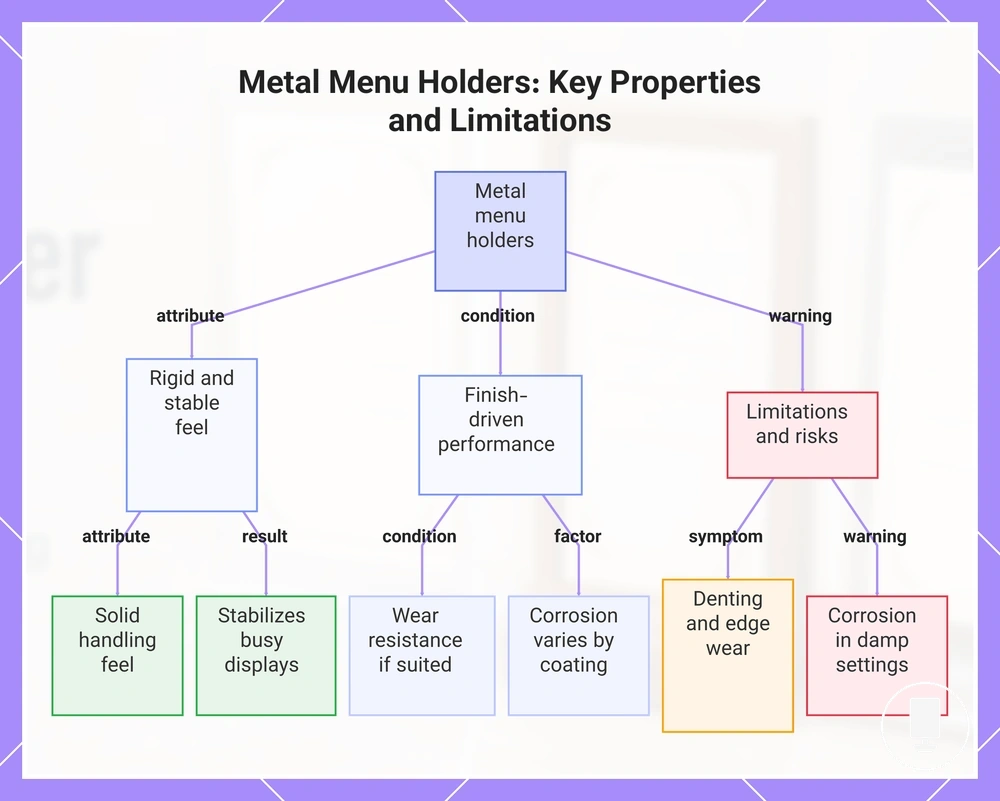
Metal menu holders may resist wear effectively when the finish is suited to the service setting, while corrosion resistance can vary depending on coating quality and environmental exposure. Added weight can support stability during handling, and smooth metal surfaces can simplify routine cleaning in many cases. Denting risk, edge wear, and surface marks may still develop when the holder is exposed to repeated impact or rough handling. In damp or outdoor-adjacent environments, corrosion may become a limitation if the finish provides limited protection.
This chart shows the main characteristics of metal menu holders, including their rigid construction, finish-dependent performance, and potential risks.
Leather-look menu holders
Leather-look menu holders use a coated surface that presents a structured and formal appearance while remaining distinct from genuine leather unless the product specification confirms otherwise. Leather-look menu holders rely on surface coating and finish details to shape their material behavior, durability, cleaning response, and handling characteristics. Their appearance and performance depend primarily on the condition of the coating and finish.
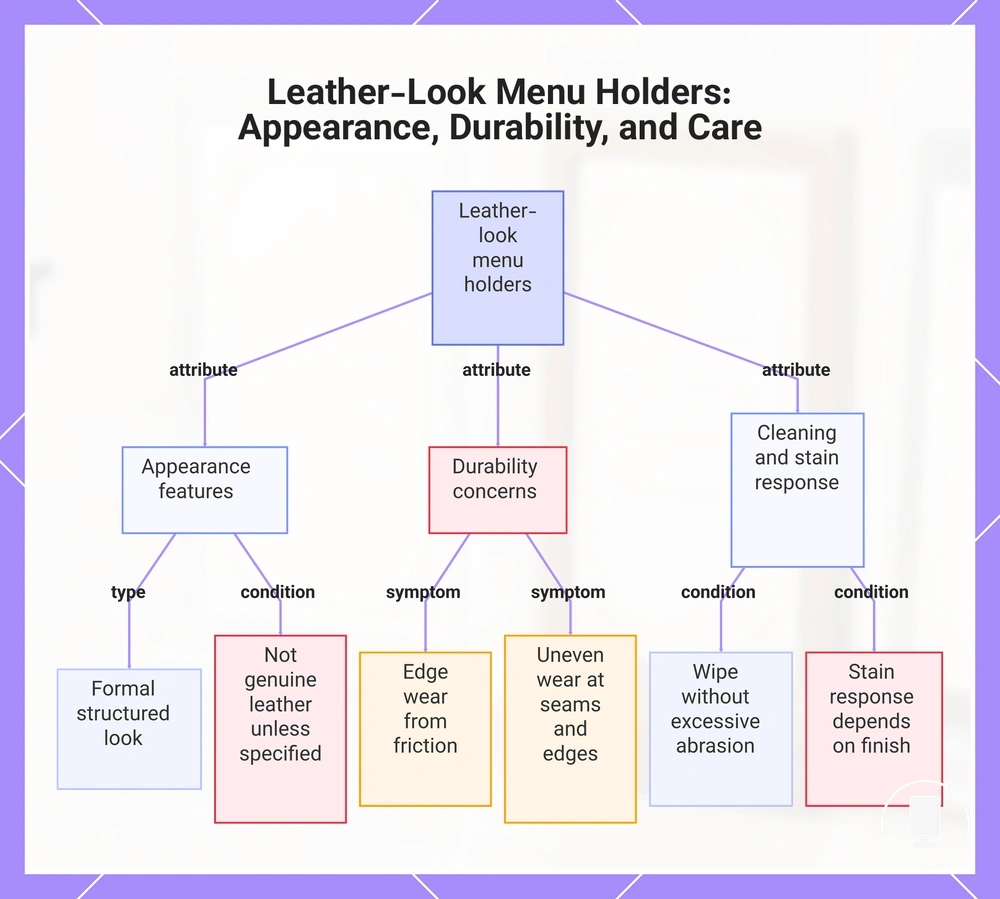
Leather-look menu holders may support routine cleaning when the coated surface can be wiped without excessive abrasion, but cleaning response can vary by finish and construction. Seams, edges, and coated surfaces may wear at different rates during frequent handling, and stain response can depend on how the finish reacts to spills or repeated contact. The material can present a formal look in many service settings, but edge wear may become more noticeable over time because seams and coated edges can experience concentrated friction during use.
This chart shows the main characteristics of leather-look menu holders, including their appearance features, durability concerns, and cleaning considerations.
PVC and clear plastic menu holders
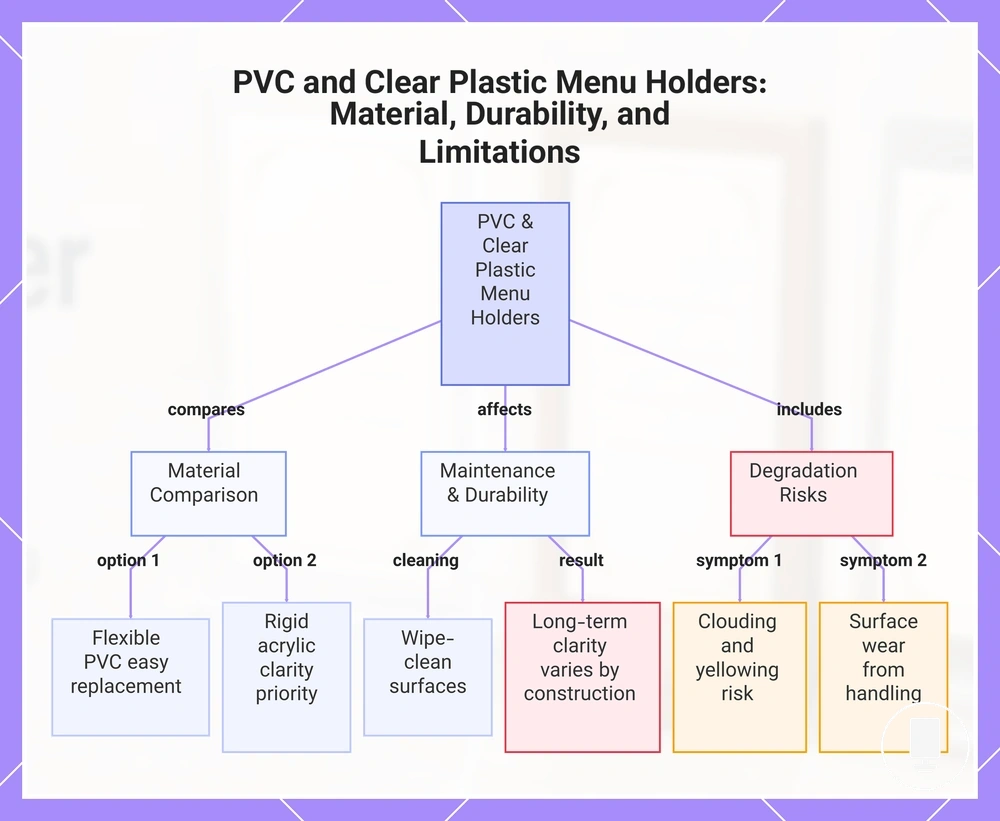
PVC and clear plastic menu holders use transparent or semi-transparent materials that can provide surface protection while supporting menu visibility. PVC and clear plastic menu holders often differ from rigid acrylic because flexible constructions can flex more easily during handling, while rigid transparent materials may emphasize clarity. Their material behavior, durability, cleaning response, and appearance depend largely on thickness, finish, and handling frequency.
PVC and clear plastic menu holders can support routine cleaning through wipe-clean surfaces, but long-term clarity may vary by construction and service setting. Flexible PVC constructions may help protect inserted menus and can be easier to replace when surface wear becomes noticeable, while rigid transparent alternatives may prioritize clarity over flexibility. Clouding, yellowing, or surface wear may develop over time depending on finish quality, exposure conditions, and repeated handling, which can become a limitation when maintaining a clear appearance is important.
This chart compares the material characteristics, maintenance aspects, and degradation risks of PVC and clear plastic menu holders relative to rigid acrylic.
Durability trade-offs by menu holder material
Durability trade-offs depend on how a menu holder material responds to scratches, dents, moisture, bending, and edge wear rather than on a single material score. Different materials may resist one damage pattern while remaining more vulnerable to another, which means replacement risk depends on finish quality, handling conditions, and service intensity. Durability trade-offs are therefore conditional rather than universal.
The table below compares menu holder material choices through durability attributes, risk conditions, and likely damage patterns. The comparison focuses on replacement implications instead of treating any material as the most durable in every setting.
| Material | Durability attribute | Risk condition | Effect or replacement signal |
|---|---|---|---|
| Acrylic | Clear surface visibility | Frequent contact causing scratches | Reduced visibility may increase replacement risk |
| Wood | Finished surface stability | Moisture exposure affecting wood finish | Surface wear or swelling risk may affect appearance |
| Metal | Rigid construction | Impact, dents, or damp conditions | Denting or corrosion may increase visible wear |
| Leather-look | Coated surface and seams | Edge wear from repeated handling | Visible wear may become more noticeable over time |
| PVC and clear plastic | Flexible protective construction | Bending, clouding, or heavy handling | Surface distortion may increase replacement risk |
The most important wear pattern usually depends on material type rather than overall damage resistance. Acrylic may scratch while retaining shape, wood may absorb moisture when finish protection is limited, and metal may dent or corrode under certain conditions. Leather-look surfaces may show edge wear around seams, while PVC may bend or cloud when handling frequency is high. These damage patterns help explain why replacement risk varies by use condition rather than by material category alone.
For high-traffic service, the more useful criterion is whether a material limits the most common damage pattern in that environment. Careful indoor use may place greater emphasis on appearance-related wear such as scratches or edge wear, while rough handling may increase concern about dents, bending, or repeated contact damage. For examples of wear-related issues that can affect long-term use, see common material problems. The most suitable durability outcome depends on service intensity, finish quality, and handling conditions.
Cleaning and wipe-clean suitability by material
Cleaning and wipe-clean suitability by material depends on surface texture, seams, moisture tolerance, and scratch sensitivity rather than on material type alone. A menu holder material with a smoother cleaning surface may require less cleaning effort, while textured surfaces or exposed seams may retain more visible residue. Wipe-clean suitability is therefore closely tied to surface condition and finish.
Cleaning and wipe-clean suitability by material is easier to compare when each material is viewed through cleaning fit and caution points. The table below focuses on cleaning effort, stain risk, moisture risk, and visible residue outcomes rather than detailed maintenance procedures.
| Material | Cleaning fit | Main caution | Safe wording |
|---|---|---|---|
| Acrylic | Smooth cleaning surface | Smudges and scratches may become visible | Use a wipe method suitable for the finish |
| Wood | Depends on finish care | Moisture risk may affect the surface | Moisture exposure should follow finish guidance |
| Metal | Usually supports regular cleaning | Visible residue may show on certain finishes | Cleaning suitability varies by surface finish |
| Leather-look | Coated surfaces can support routine wiping | Seams, coating wear, and stain risk | Follow finish-specific care guidance |
| PVC and clear plastic | Often supports wipe-clean use | Clouding, residue visibility, or surface wear | Cleaning response depends on finish and handling |
Acrylic cleaning surfaces may show smudges and scratches more readily because clear surfaces can make marks easier to notice. Wood surfaces may require additional finish care because moisture tolerance can vary by coating and construction. Leather-look menu holder material may show staining or edge wear around seams and coated areas, while metal surfaces may show visible residue depending on surface texture and finish. These differences affect cleaning effort even when regular cleaning routines are similar.
PVC and clear plastic menu holder material can support routine wiping, but clouding, surface wear, or residue visibility may change appearance over time. Surface texture and handling frequency can influence how quickly marks become noticeable, while stain risk may vary by finish condition. A washable surface does not necessarily mean every wipe method is suitable, especially when coatings, seams, or clear surfaces require care. Material-specific cautions are often more useful than assuming equal cleanability across all materials.
Cleaning method should follow the holder finish and supplier instructions because moisture tolerance, coating condition, and surface texture can vary. For broader care guidance beyond material comparison, see clean and maintain menu holders. Wipe-clean suitability is best treated as a material-and-finish consideration rather than a universal cleaning outcome.
Material fit for restaurant style and service setting
Material fit depends on restaurant style, service setting, handling frequency, table density, lighting, and brand presentation rather than on material choice alone. The same menu holder material may suit one dining format while creating different trade-offs in another because service pace and display setting change which attributes matter most. Material fit is therefore linked to the conditions of use rather than to a fixed compatibility rule.
Material fit for restaurant style and service setting becomes clearer when each material is compared against the conditions it is likely to face. The fit matrix below focuses on setting-driven tendencies and the trade-offs that may influence suitability.
| Setting | Material tendency | Why it fits | Trade-off to check |
|---|---|---|---|
| Casual dining | Acrylic or PVC | May support visibility and regular handling | Scratches, clouding, or surface wear |
| Premium dining | Wood or leather-look | Often aligns with finish-focused presentation | Moisture exposure, edge wear, or stain visibility |
| Counter display | Acrylic or metal | Visibility or stability may be prioritized | Smudges, dents, or finish marks |
| High-turnover tables | Metal, acrylic, or PVC | Can support frequent handling when cleaning speed matters | Surface wear from repeated contact |
Casual dining settings often place greater emphasis on cleaning speed and handling frequency, which may make clear or easy-to-clean surfaces more practical. Premium dining environments may give more weight to finish quality and brand presentation, so wood or leather-look materials can align with the intended atmosphere when maintenance demands are acceptable. Counter use may increase the importance of visibility or stability depending on how menus are accessed within the display setting. High handling frequency can shift priorities toward cleanability and wear management because repeated contact may increase the visibility of scratches, residue, or edge wear.
Material fit should be evaluated through service conditions rather than through placement mechanics. Table density, lighting conditions, handling frequency, footprint requirements, and brand presentation can change which material attributes become more relevant within a particular service setting.
Best material choices by decision priority
Decision priority determines which material option is likely to fit a menu holder use condition more appropriately. Cleaning speed, durability, presentation, and value priority often lead to different material choices because each criterion emphasizes a different attribute. The most suitable material choice depends on which priority matters most in the service setting.
Best material choices by decision priority become easier to compare when each priority is matched to a likely material fit and its trade-off. The table below focuses on selection criteria rather than treating any material as a universal choice.
| Priority | Likely material fit | Trade-off | Check before choosing |
|---|---|---|---|
| Cleaning speed | Acrylic or PVC | Scratches, clouding, or visible wear may develop | Assess handling frequency and wipe-clean needs |
| Durability | Metal | Weight, dents, or finish marks may become noticeable | Consider handling conditions and service pace |
| Presentation | Wood or leather-look | Finish care and stain visibility may require attention | Match appearance expectations to maintenance needs |
| Value priority | Depends on replacement risk and service condition | No single material fits every use condition | Balance lifespan, appearance, and handling demands |
When cleaning speed is the main decision priority, acrylic and PVC may suit environments where regular wiping and menu visibility matter. When durability is prioritized, metal may fit service settings that involve frequent handling and a greater focus on structural stability. Presentation-focused environments may favor wood or leather-look materials because finish and appearance can contribute to a stronger visual impression. Value priority often depends on how replacement risk, maintenance expectations, and service conditions interact over time.
Each material option involves a trade-off that should be evaluated alongside the intended use condition. A material that supports faster cleaning may show surface wear more readily, while a material chosen for presentation may require greater finish care. Selection priority is often more useful than comparing materials through a single attribute.
A practical material choice starts by identifying the primary decision priority and then checking whether the associated trade-offs are acceptable for the service setting. For broader selection guidance, see choose the right menu holders.
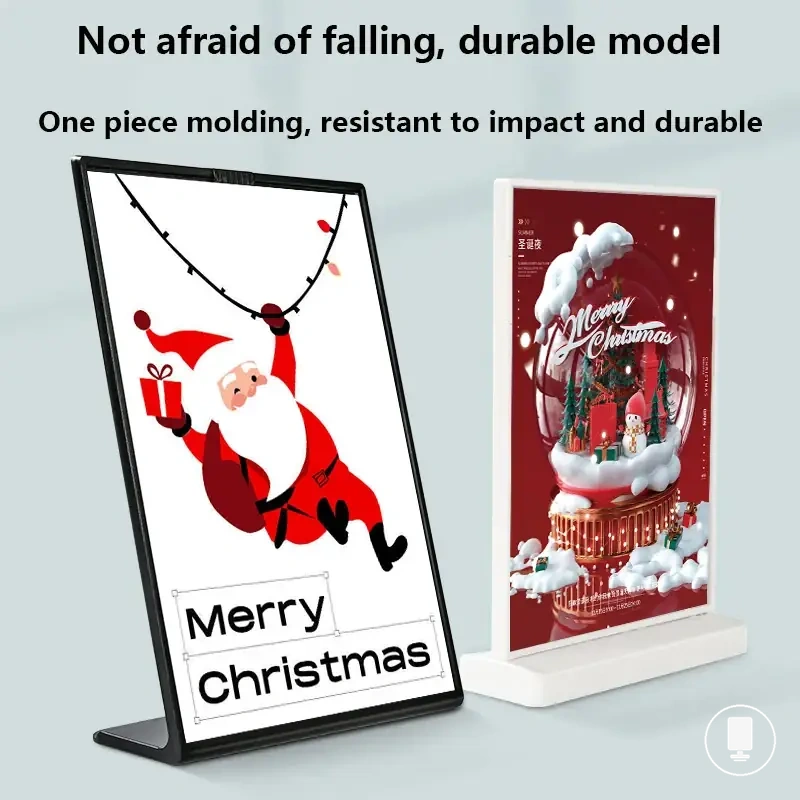
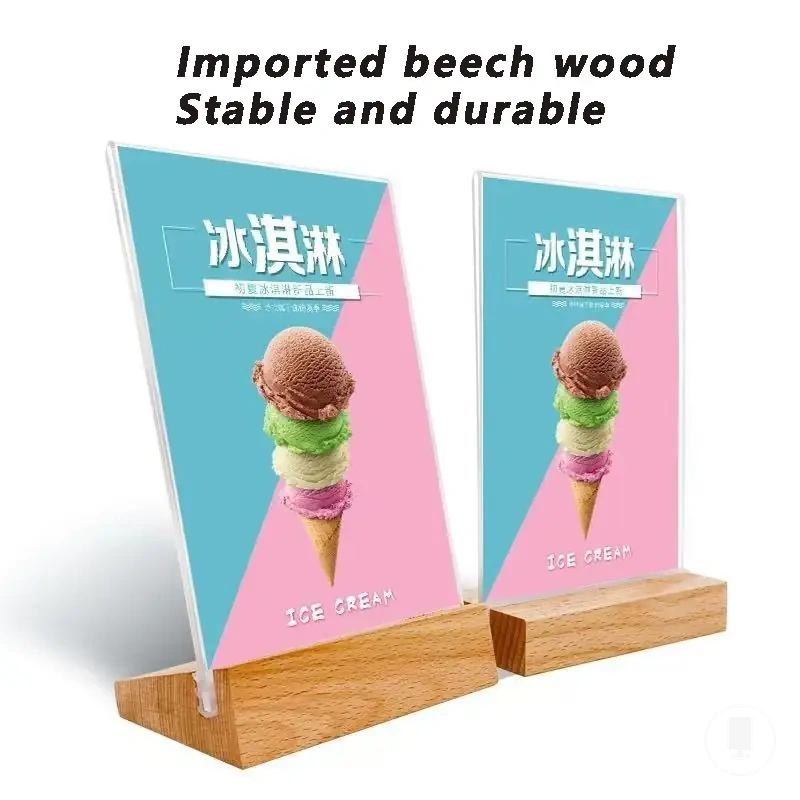
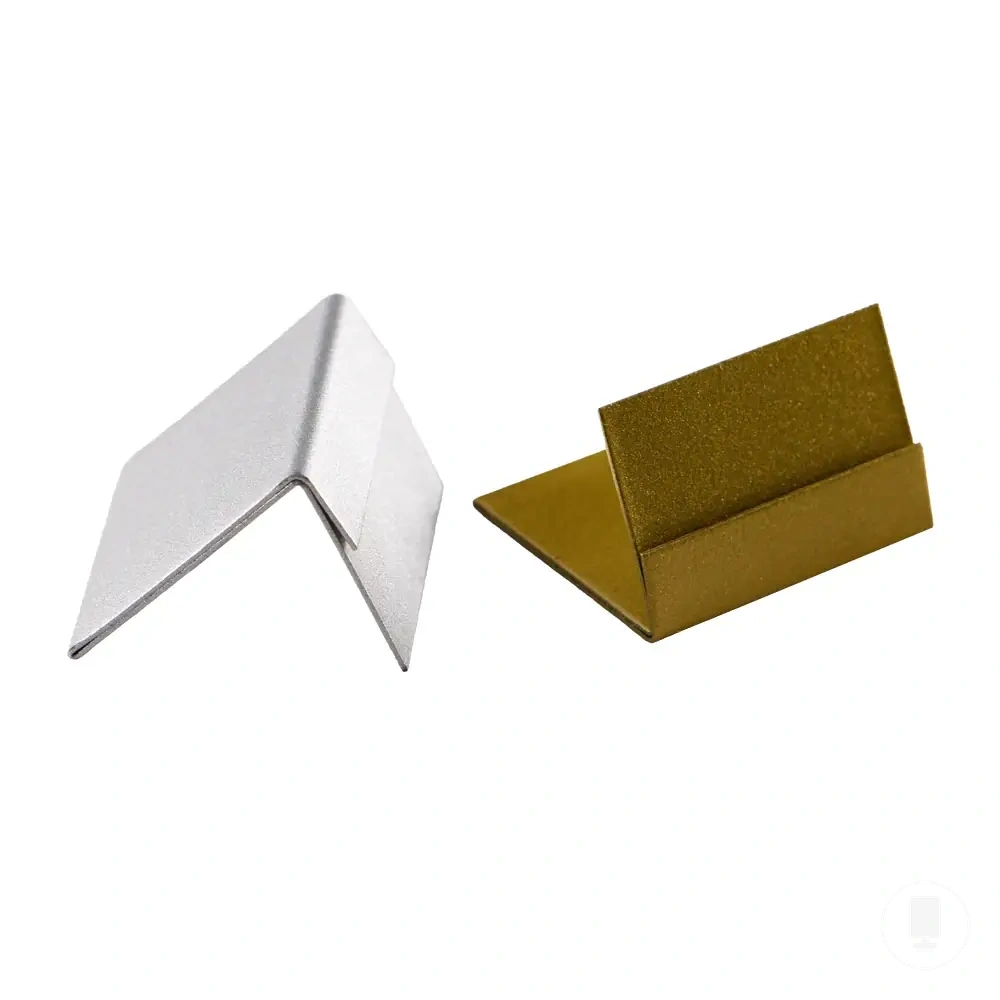
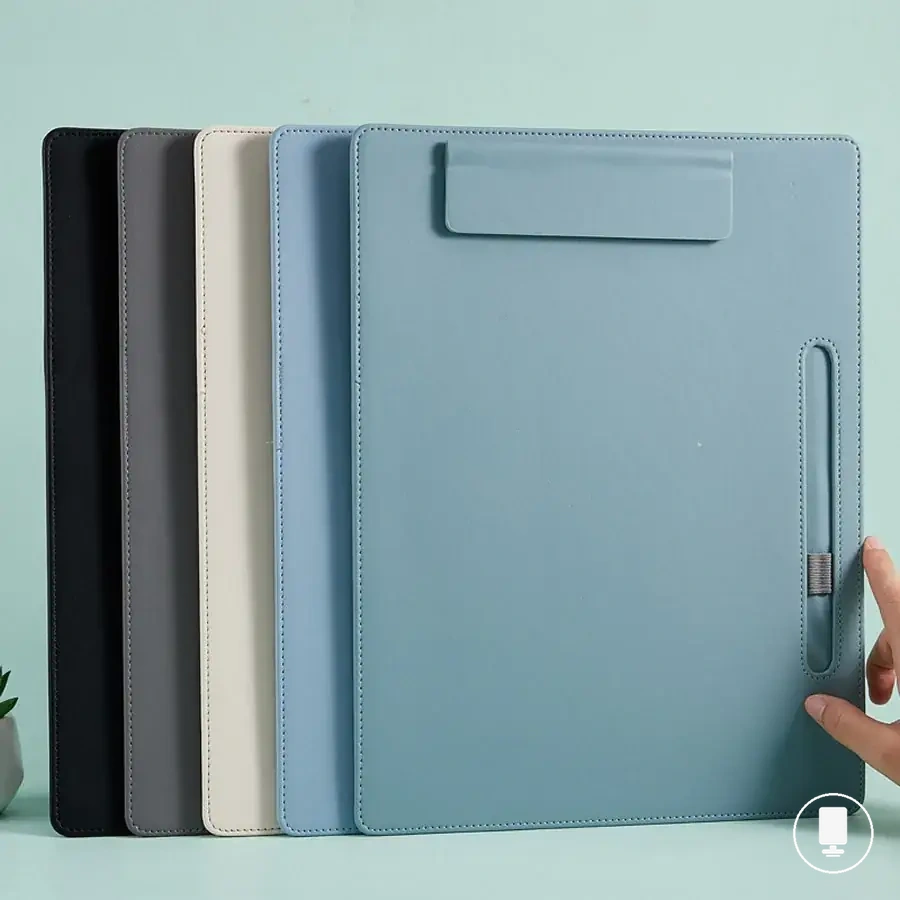
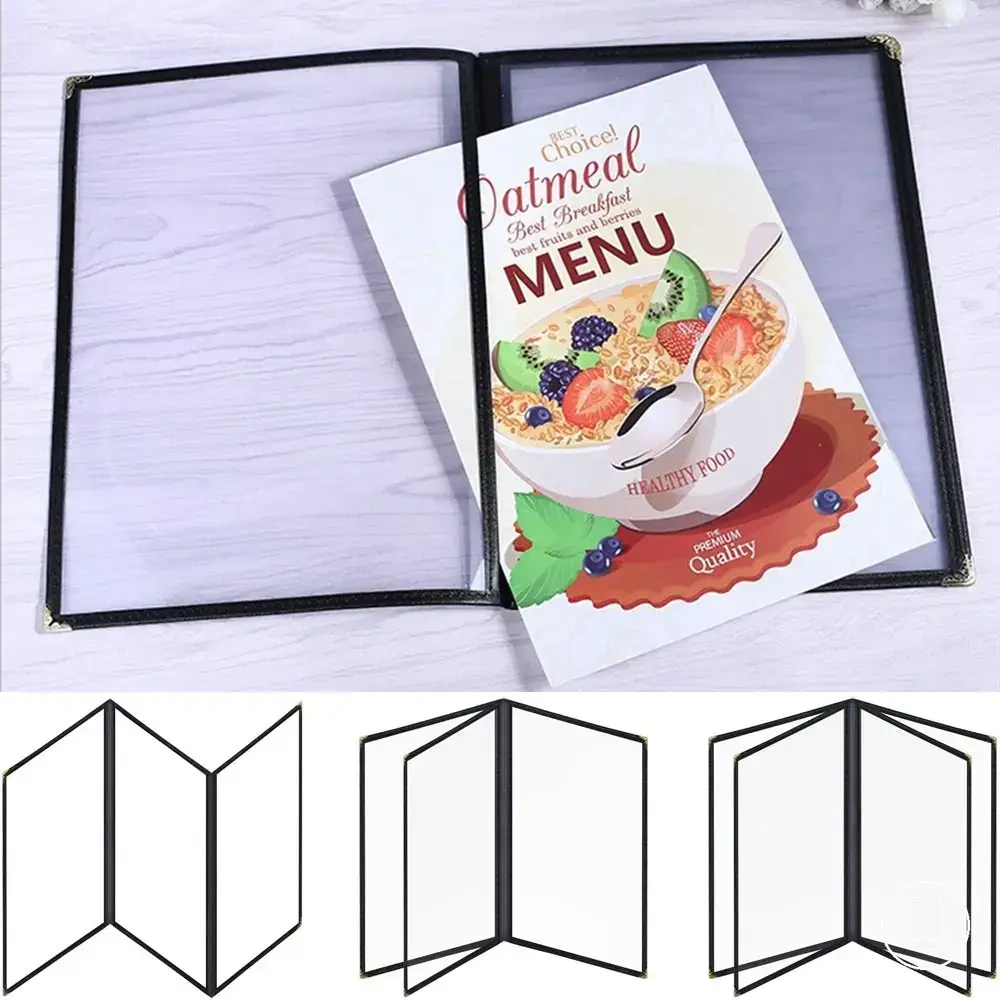
Here are product examples that may make comparison easier. Before buying, always review the compatibility criteria, essential features, and product details.
High-turnover tables and quick cleaning
High-turnover tables create repeated handling, frequent wiping, and faster decisions about whether a menu holder surface remains presentable. In this setting, quick cleaning depends on a wipe-clean surface, low crevice count, manageable scratch visibility, and moisture tolerance. High-contact table use therefore depends on surface behavior that can be checked quickly without implying any hygienic guarantee.
Use this short checklist to connect quick cleaning with table turnover and repeated handling:
- Surface: Check whether the holder has a smooth wipe-clean surface that does not trap visible residue easily.
- Crevices: Prefer a low crevice count when fast service requires frequent wiping between uses.
- Visibility: Consider scratch visibility because clear or glossy surfaces may show marks more quickly under repeated handling.
- Moisture: Check moisture tolerance where regular wipe-downs may expose edges, seams, or finishes to repeated contact.
- Practical check: Confirm that the material can be wiped, inspected, and returned to the table without visible residue or surface wear becoming a frequent service issue.
Premium dining presentation
Premium dining presentation depends on how finish, texture, weight, and color harmony work together within the table setting. In a formal setting, material choice can influence perceived quality because guests often notice surface appearance before interacting with the menu holder. Material finish and texture therefore directly support presentation.
A warm wood texture can support a refined look when its finish complements surrounding décor and color harmony. Leather-look surfaces may suit a formal setting because a structured finish can signal formality, while metal can contribute a modern look when weight and surface treatment complement the intended presentation. These appearance attributes should be considered separately from cleaning or wear expectations because presentation value does not automatically indicate durability. Readability remains the final boundary, since menu format, lighting conditions, and surface contrast should not distract from viewing menu content.
Longer-term value and replacement risk
Longer-term value depends on how material durability, cleaning wear, damage risk, and handling level influence replacement risk and cost over time. A menu holder material that remains suitable for its service conditions may reduce replacement frequency, while visible wear or damage can increase replacement risk. Value is therefore use-case dependent rather than price-only.
Use this compact checklist to evaluate material durability and replacement conditions:
- Damage risk: Check whether scratches, dents, bending, staining, or edge wear are likely under the expected handling level.
- Cleaning wear: Consider whether repeated wiping may affect the surface finish, coating, clarity, or texture.
- Handling frequency: Match the material to the expected handling level instead of assuming equal durability across all settings.
- Replacement trigger: Identify when visible wear, reduced clarity, surface damage, or cleaning difficulty may make replacement more likely.
For example, a material that appears suitable for occasional use may show cleaning wear or edge wear more quickly in a high-contact setting, which can increase replacement risk and affect cost over time. When comparing material choices, menu holder value factors can provide additional criteria beyond initial selection. Longer-term value depends on how material durability, cleaning wear, and replacement trigger align with real-world handling conditions.
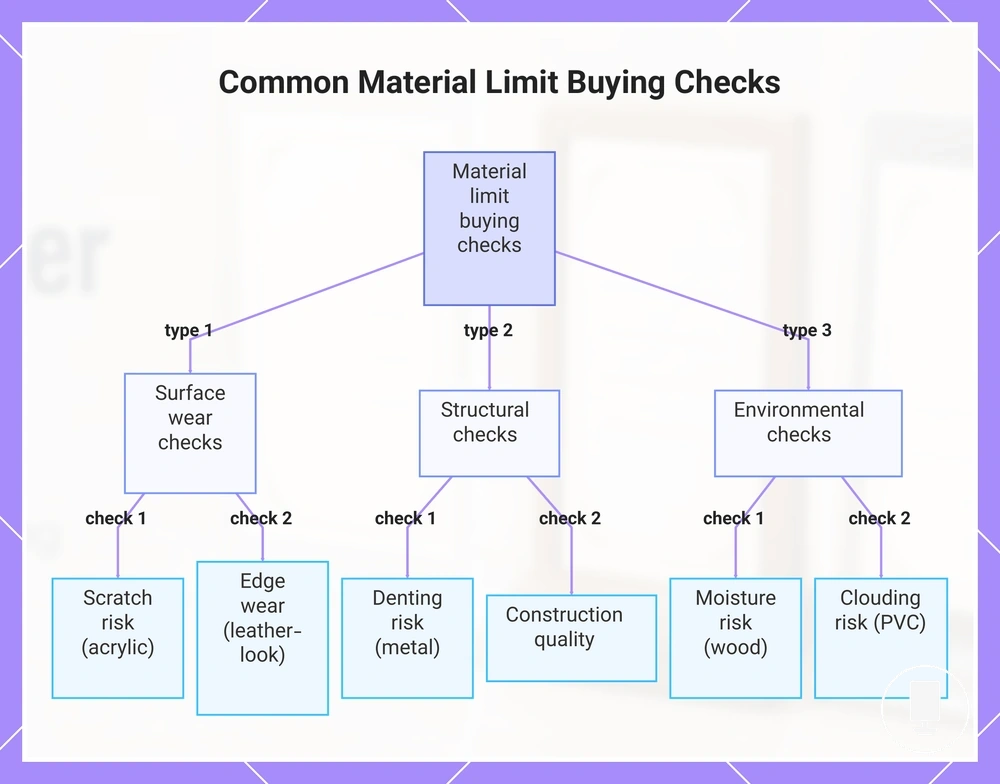
Common material limits before buying
Material limits should be checked before buying because finish, thickness, construction quality, and service conditions can affect how a menu holder performs over time. Scratch risk, moisture risk, denting, staining, clouding, edge wear, and cleaning restrictions do not affect every material equally. These material limits are most useful as buying checks rather than warnings.
The checklist below helps compare material weaknesses through real use conditions instead of broad assumptions. Each point connects a material limit to a condition that may influence the next-step decision.
- Acrylic: Check scratch risk when a clear surface is likely to experience frequent contact because reduced visibility may become more noticeable over time.
- Wood: Check moisture risk when coatings, finishes, or service conditions may expose the surface to repeated liquid contact.
- Metal: Check denting risk when handling conditions involve impact, movement, or repeated contact.
- Leather-look: Check edge wear when seams and coated edges are likely to experience regular handling.
- PVC and clear plastic: Check clouding when cleaning wear or repeated handling may affect surface clarity.
- Coated surfaces: Check staining risk when spills, residue, or finish condition may affect appearance.
- Construction quality: Check thickness, joins, and overall construction quality because material limits may worsen when support points are weaker.
- Cleaning restrictions: Check whether the finish requires specific cleaning methods before assuming routine wiping is suitable.
Scratch risk, moisture risk, denting, clouding, and edge wear become more relevant when service conditions increase handling frequency or surface exposure. Whether a limitation is severe enough to reject a material depends on the intended use, finish condition, and construction quality rather than on the material category alone. Buying checks are most useful when they focus on the likely source of wear instead of isolated material attributes.
For additional examples of how wear conditions can affect material performance, see common material problems. This clarification can help separate manageable caution points from conditions that may increase replacement risk.
A final buying decision should compare material limits against the expected service environment, cleaning routine, and handling level. The goal is not to eliminate every material weakness, but to identify which caution points are acceptable for the intended use.
Here are product examples that may make comparison easier. Before buying, always review the compatibility criteria, essential features, and product details.
This chart groups key material-specific checks for menu holders into surface wear, structural, and environmental categories to guide buying decisions.