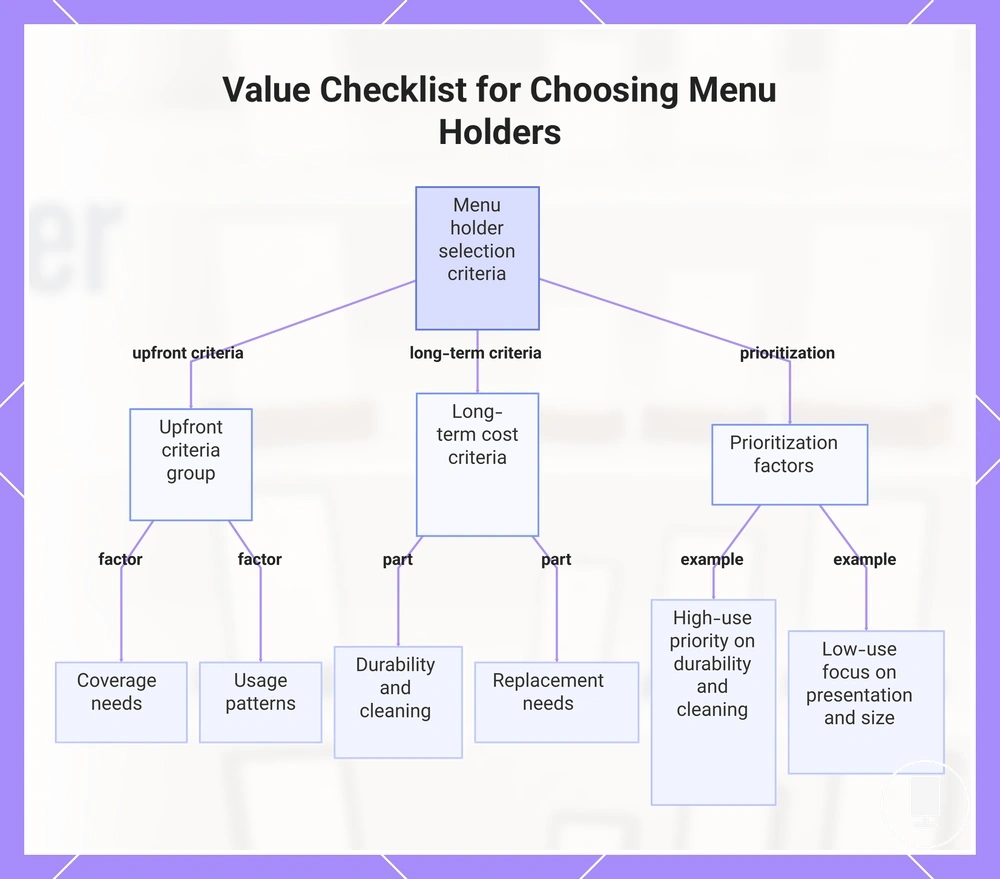
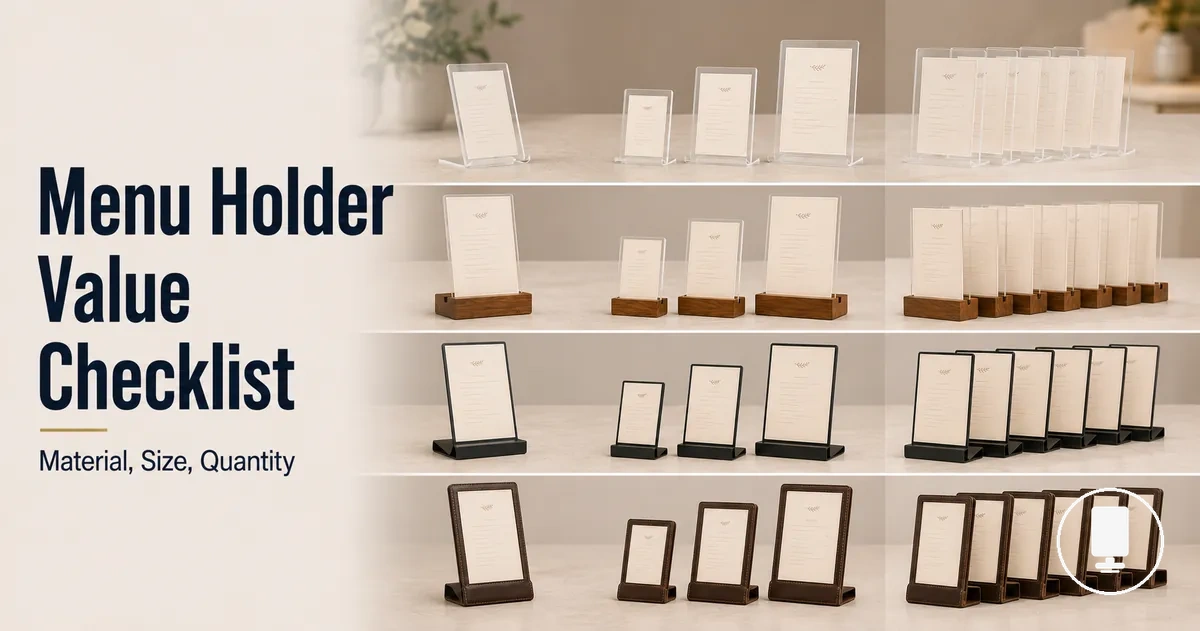
Menu holder price and value guide
Menu holder price defines a cost-value decision, not only a purchase amount. For restaurants and similar table-service contexts, menu holders should be judged by how material, size, quantity, durability, and replacement timing support clear presentation over repeated use.
Menu holder price varies by material, size, pack quantity, construction, finish, supplier, customization, and market conditions. A lower starting cost may offer value when the holder fits the table-service context, but a higher-cost option may be easier to justify when cleaning load, visibility, spare units, or replacement timing matter more.
In a restaurant table setting, value often comes from matching the holder pack to per-table need, insert format, and expected handling. A menu holder set can look economical at first, but the long-term cost can change when spare units, cleaning frequency, durability, and presentation consistency are considered together.
Menu holders should also be separated from menu covers, menu boards, and broader display products when comparing price. Those adjacent formats may follow different cost factors, so this guide keeps the boundary on table menu holders and holder packs before moving into typical price range interpretation.
Typical menu holder price ranges and what they include
Typical menu holder price ranges are indicative rather than fixed, and they usually reflect differences in material, size, pack quantity, finish, insert capacity, and condition. Typical menu holder price ranges are most useful when interpreted as signals of what may be included and how those attributes can influence durability and presentation value.
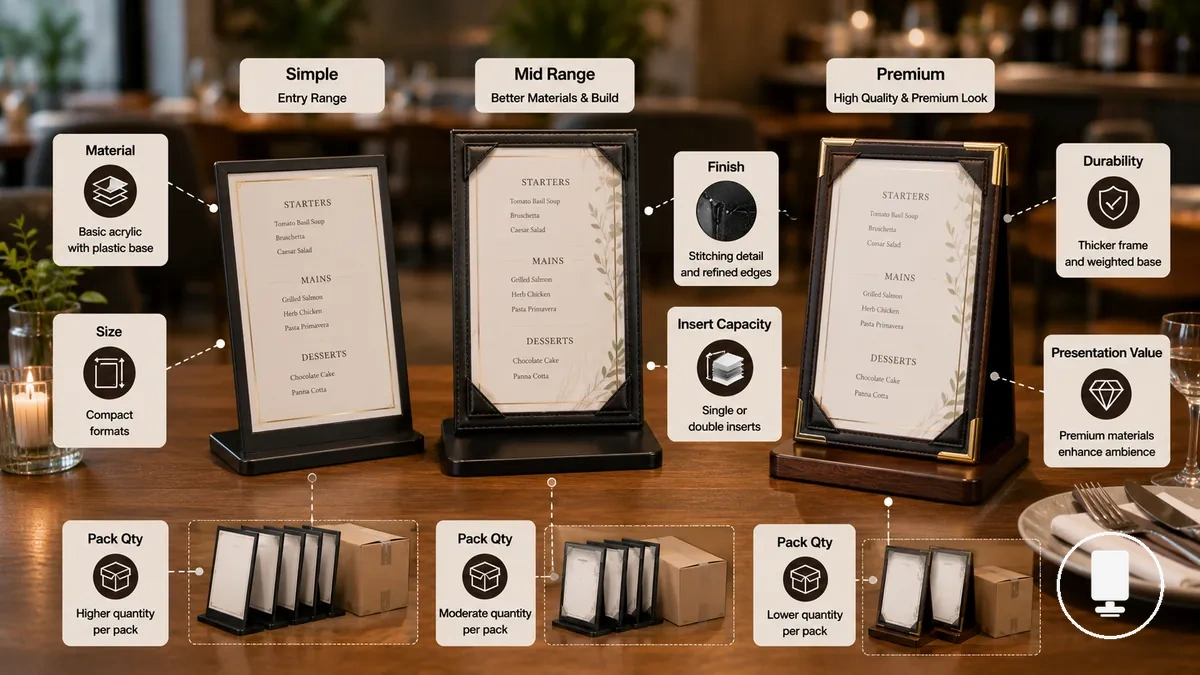
For menu holders, a price range often reflects the combination of included components and presentation characteristics rather than a single feature. Material choice, surface finish, insert capacity, and pack quantity can change what is included within a menu holder set. Condition and construction quality may also influence expected durability, presentation value, and replacement considerations over time.
| Price signal | Usually affected by | What it may include | Value caution |
|---|---|---|---|
| Lower-cost signal | Basic material, smaller size, lower pack quantity | Standard finish and simpler insert capacity | Lower initial cost may not reflect longer-term replacement needs |
| Mid-cost signal | Balanced material, size, and quantity choices | Improved finish, broader insert capacity, or added presentation features | Compare included components before judging expected value |
| Higher-cost signal | Premium material, larger size, higher pack quantity, enhanced finish | Greater presentation emphasis and potentially stronger durability characteristics | Higher cost does not automatically mean a better fit for every table-service context |
A single table menu holder may require a different cost evaluation than coverage for multiple restaurant tables. Pack quantity and spare units can influence expected value when planning for replacement timing, cleaning demands, or presentation consistency across a dining area. These comparisons are most useful when carried forward into a closer evaluation of cost factors.
Menu holder price boundaries versus menu covers and menu boards
Menu holders are the priced subject of this guide, and menu holders are distinct from menu covers, menu boards, full signage, and broader display systems. A clear pricing boundary keeps menu holder price evaluation focused on table menu holders rather than on menu presentation products with different display functions, physical formats, replacement patterns, and cost drivers.
Menu holder price boundaries versus menu covers and menu boards separate menu holder pricing scope from adjacent display products that can otherwise distort price expectations.
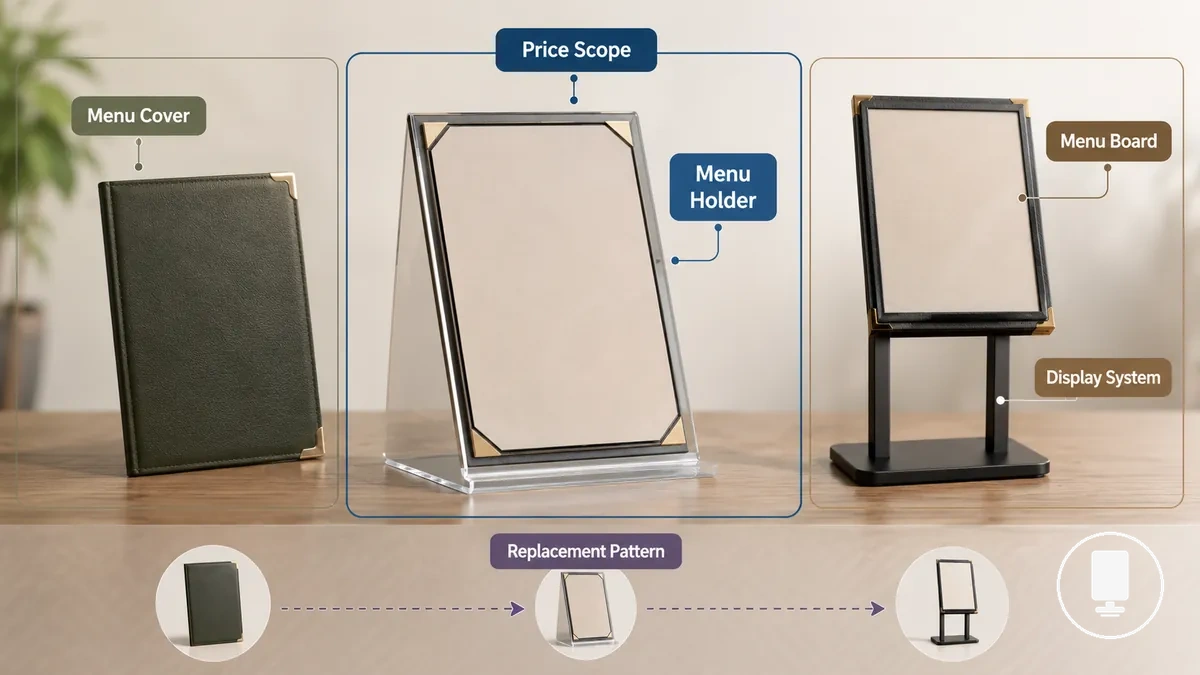
- Inside menu holder pricing: Table menu holders, holder-based menu presentation formats, and replacement considerations tied directly to the holder.
- Adjacent display pricing: Menu covers, menu boards, signage, and display systems that may follow different display functions, physical formats, and cost drivers.
Menu covers often serve a different menu presentation role than table menu holders, while menu boards and display systems may support broader display purposes. Because physical format and replacement pattern can differ across these categories, price expectations may not transfer directly from one category to another.
Pricing boundary clarity helps prevent confusion when comparing menu presentation products. Keeping the scope on menu holders ensures that later cost-factor evaluation remains relevant to the priced subject rather than to adjacent display categories.
Main factors that change menu holder cost
Main factors that change menu holder cost include menu holder material, size, finish, construction quality, durability, cleaning demand, and customization. These cost factors are most useful when treated as decision criteria because each attribute can create a different value effect depending on presentation needs, usage frequency, and replacement considerations.
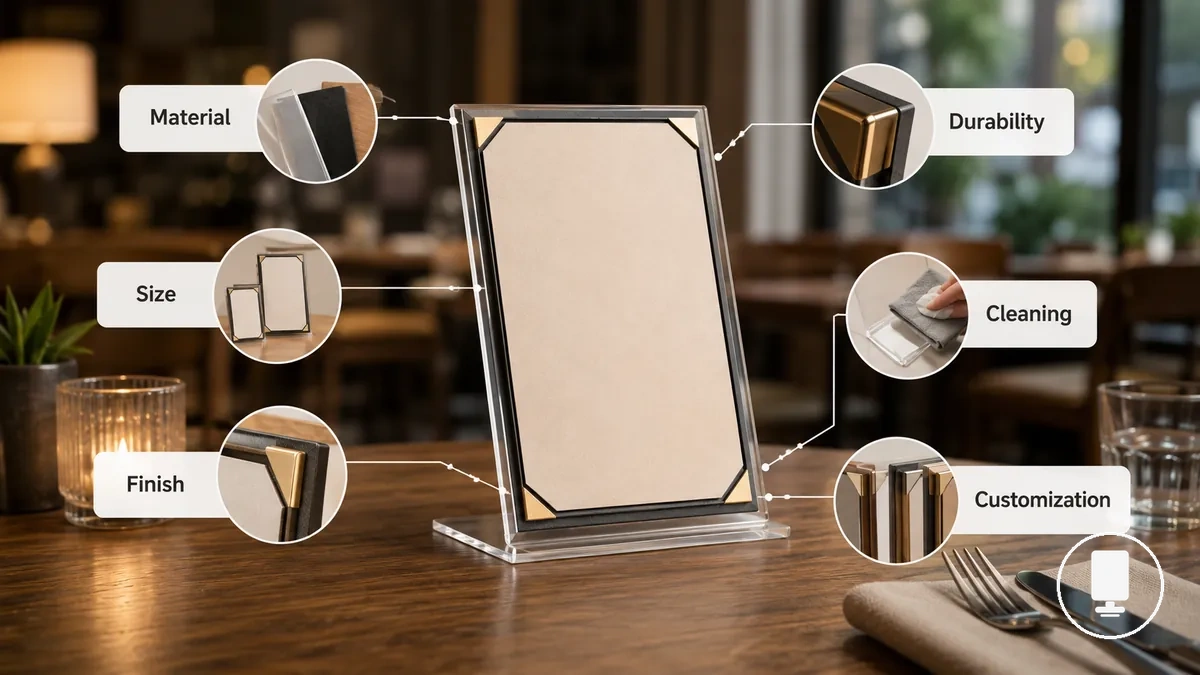
Similar-looking menu holders can have different prices when attributes influence usability, maintenance effort, or expected service life in different ways. Size can affect display area and insert capacity, while finish can influence appearance and cleaning demand. Construction quality and durability may affect replacement risk, and customization can add presentation-focused requirements that change cost signals.
Main factors that change menu holder cost are easier to evaluate when attributes are connected to their value effects. The table below connects common decision criteria to potential cost and value outcomes, while related topics such as materials that affect price and sizes that affect menu holder cost provide more detailed context.
| Factor | Attribute or condition | Cost effect | Value decision |
|---|---|---|---|
| Menu holder material | Material type and appearance | May influence production and replacement considerations | Assess whether the material supports the intended use case |
| Size | Display area and insert capacity | Can affect overall holder requirements | Match size to menu presentation needs |
| Finish | Surface treatment or visual presentation | May change appearance-related cost signals | Consider presentation goals and maintenance expectations |
| Durability | Expected resistance to repeated handling | Can influence replacement frequency | Compare long-term value rather than feature volume alone |
| Cleaning demand | Ease and frequency of cleaning | May affect ongoing maintenance effort | Consider operating conditions and upkeep requirements |
| Customization | Branding or presentation-specific changes | Can add cost beyond standard configurations | Pay for customization when it supports a clear purpose |
Value is often determined by whether a cost factor supports a real requirement rather than by the number of features included. Focusing on relevant price drivers helps separate necessary cost drivers from optional presentation upgrades.
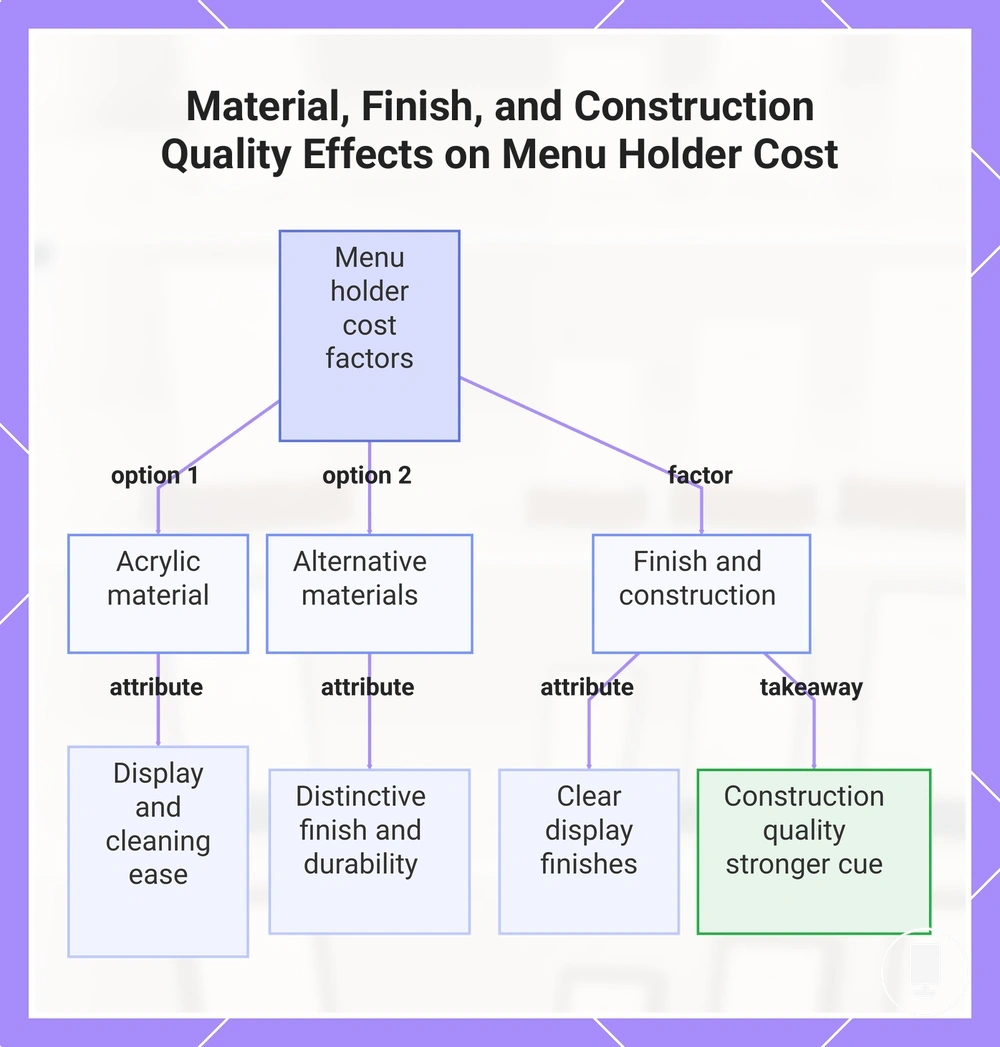
Material, finish, and construction quality
Material, finish, and construction quality affect menu holder cost because each attribute influences presentation, cleaning effort, durability expectations, weight, and the likely price band. Material and surface finish should be evaluated as cost factors within the broader value decision rather than as isolated features.
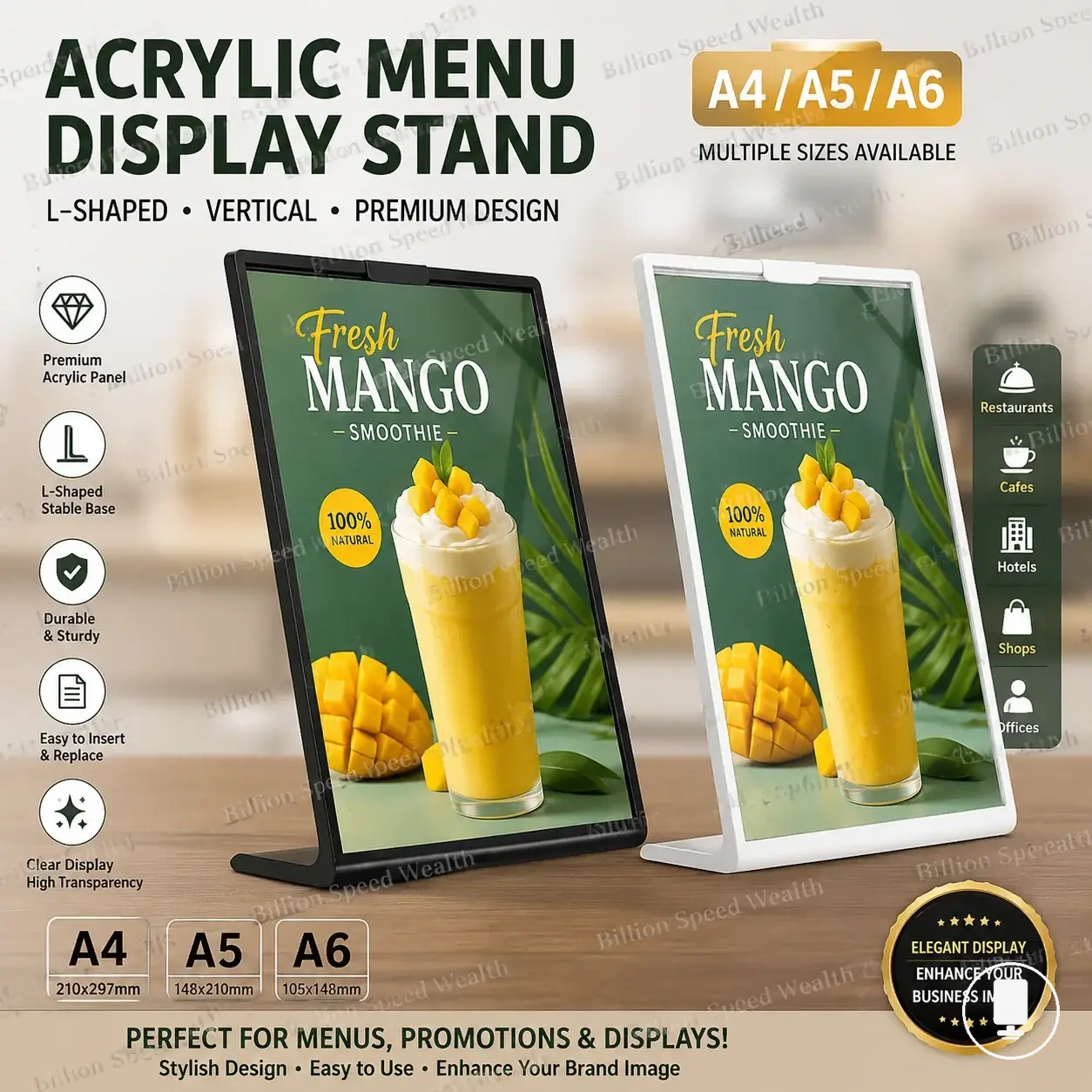
- Acrylic: Acrylic material often supports a clear display and strong menu visibility. Cleaning effort may be straightforward, while the price band can vary with finish and construction quality.
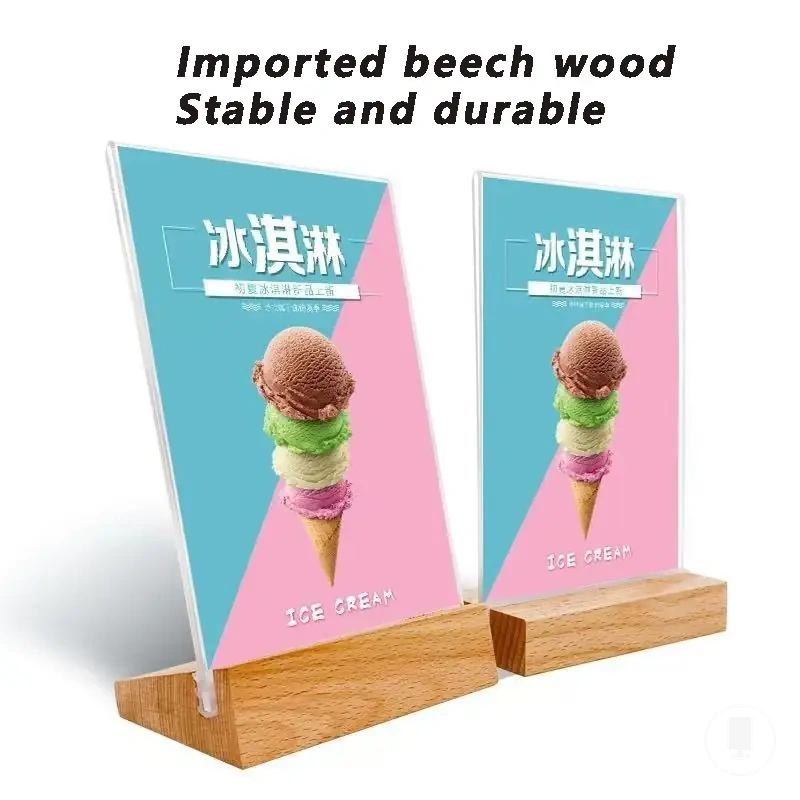
- Wood: Wood material can support a distinctive presentation finish. Maintenance needs and finish quality may influence value expectations and price band differences.
- Metal: Metal material may signal greater weight and stability. Durability expectations can vary by construction quality, finish, and usage conditions.
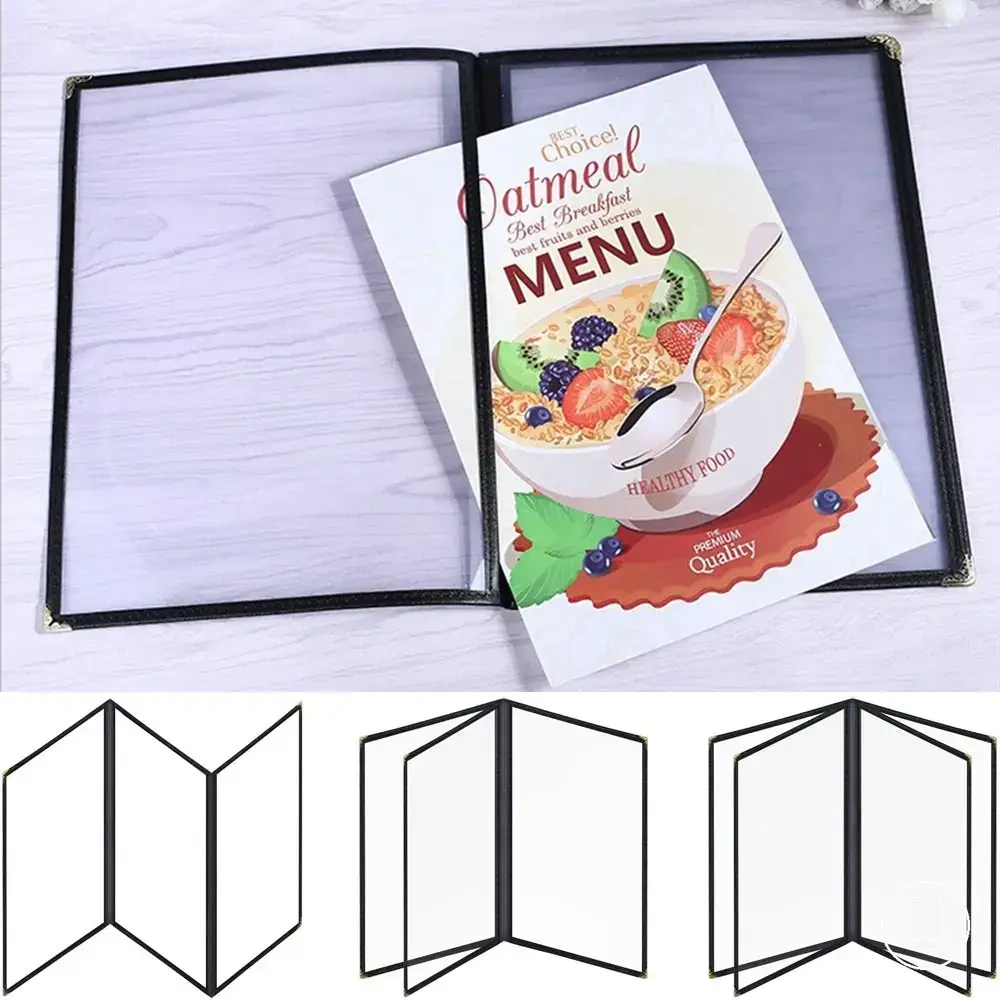
- Leather-look: Leather-look material can support a different presentation style and display finish. Price band differences may depend on build quality, finish detail, and intended use.
- Clear display finishes: Clear display finishes often emphasize menu visibility and accessibility. Cost and value effects may depend on construction quality, cleaning demand, and display requirements.
Construction quality often provides a stronger value cue than material type alone when comparing menu holders within a similar price band. The most suitable material and finish depend on how presentation, maintenance, and expected use are balanced.
This chart shows how material type, finish, and construction quality influence menu holder cost and value.
Size, insert format, and display capacity
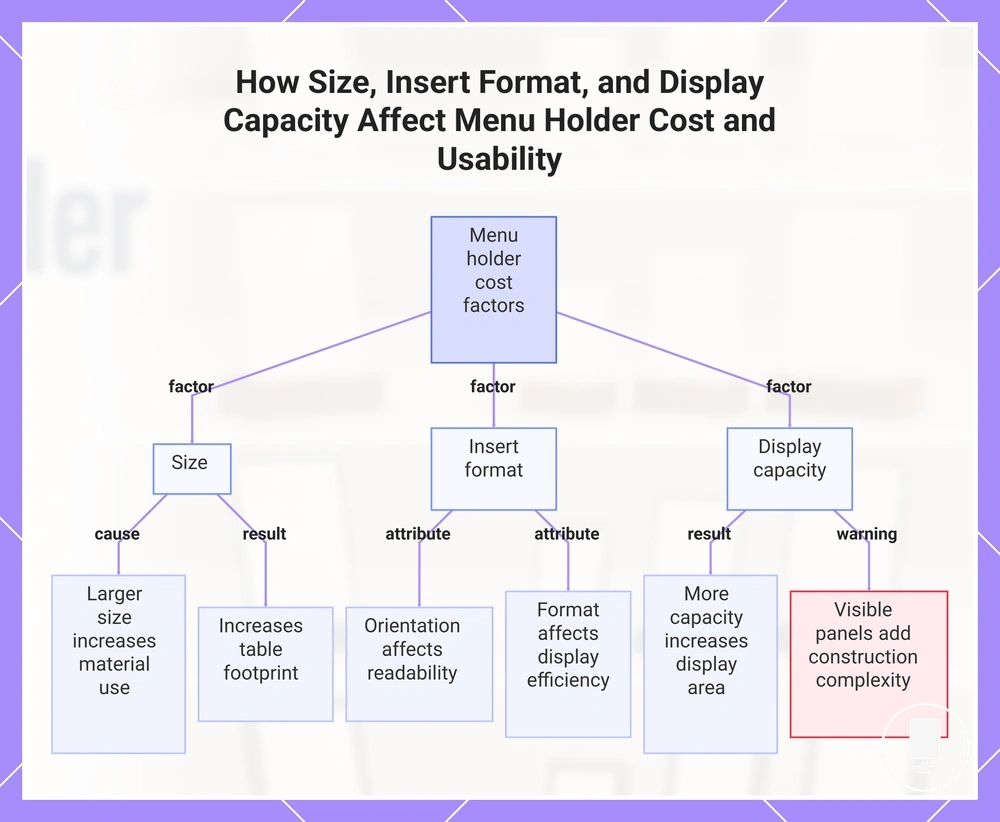
Size, insert format, and display capacity affect menu holder cost because larger or multi-insert formats can require more material, added construction, and a larger table footprint. Insert orientation, visible panels, and page capacity can also affect usability, while display area requirements may influence overall cost and presentation choices.
- Size: Larger size formats can increase material use and construction requirements, which may affect cost and table footprint.
- Insert format: Insert format and menu format choices can affect display capacity and how efficiently menu content is presented.
- Orientation: Orientation can affect readability and usability when menu layout, table space, or viewing distance varies.
- Visible panels and page capacity: Additional visible panels or greater page capacity can support more content but may require a more complex holder design.
- Display capacity: Greater display capacity can increase display area and presentation options, while usability depends on content density and available table space.
Within the broader cost-factor evaluation, size and insert capacity create value when the menu holder supports the required content without adding unnecessary table footprint or construction complexity.
This chart shows how the three key attributes of a menu holder—size, insert format, and display capacity—influence cost, construction, and usability.
Durability, cleaning, and daily-use resistance
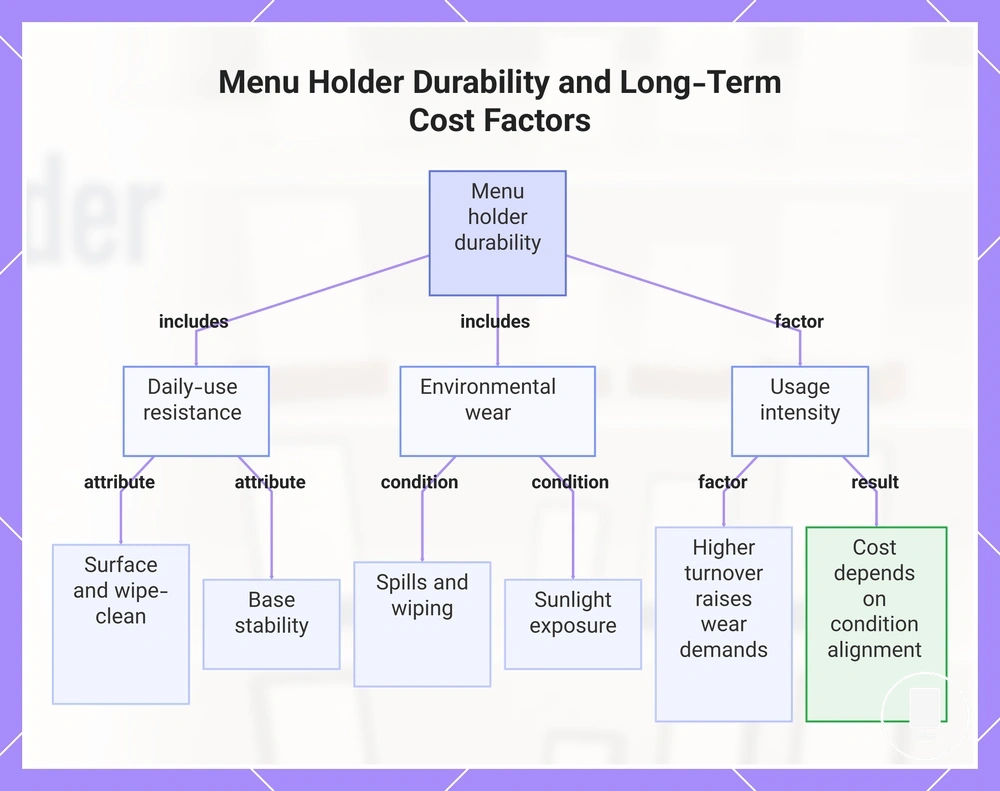
Durability, cleaning frequency, and daily handling affect long-term cost because repeated use can influence condition, appearance, and replacement risk over time. Surface resistance, wipe-clean behavior, and base stability contribute to daily-use resistance and may affect how well a menu holder maintains its presentation under regular use.
- Spills and wiping: Frequent spills and wiping can expose surfaces to repeated wear. Wipe-clean behavior may help reduce maintenance effort, depending on the material and finish.
- Scratches: Scratches may become more visible when menu holders are moved or handled often, which can affect presentation quality.
- Sunlight: Sunlight exposure may influence appearance over time, depending on material characteristics, finish, and placement conditions.
- Table turnover and handling frequency: Higher table turnover can increase daily handling, which may raise wear resistance demands and replacement risk.
- Base stability: Base stability can reduce unnecessary movement during daily use and may help limit handling-related wear.
High-use environments often place greater pressure on durability and cleaning frequency than occasional-use settings. Long-term cost outcomes depend on how surface resistance, daily-use resistance, and replacement risk align with actual operating conditions.
This chart shows the key factors affecting menu holder durability and long-term cost, including daily-use resistance, environmental wear, and usage intensity.
Custom branding and presentation details
Customization can raise menu holder cost because branding elements and presentation details add design, production, or finishing complexity. Whether customization improves value depends on its contribution to brand fit, readability, durability considerations, or replacement flexibility rather than on appearance alone.
Presentation details are most useful when they support a practical purpose. Branding that improves recognition or readability may justify added cost in certain settings, while decorative upgrades may increase cost without improving everyday usability.
- Logo placement: Logo placement may improve brand fit when it remains visible without reducing menu readability.
- Custom colors: Custom colors can support presentation consistency, but value depends on whether they help readability and visual clarity.
- Special finishes: Special finishes may add presentation appeal, while durability and cleaning outcomes can vary by finish type and use conditions.
- Branded finish or custom design: A branded finish can support a specific visual identity, but replacement flexibility may become more limited than with standard presentation details.
- Premium presentation features: Premium presentation features add cost, and their value depends on whether they improve brand fit, readability, or another practical requirement.
Practical branding supports a defined presentation goal, while decorative customization can increase cost without delivering the same level of functional value.
How menu holder sets and packs affect unit value
Menu holder sets and packs affect unit value when pack quantity, per-unit cost, coverage needs, and spare-unit planning are evaluated together instead of focusing only on headline pack price. A menu holder set can offer stronger value when the pack supports per-table need, provides useful spare allowance, and maintains consistency across tables.
| Pack factor | What to check | Value effect | Caution |
|---|---|---|---|
| Pack quantity | Number of holders compared with actual coverage requirements | Can improve unit value when quantity matches table coverage | Extra units may add cost without improving practical value |
| Per-unit cost | Cost of each holder within the pack | Helps compare different pack sizes on a consistent basis | Lower per-unit cost does not automatically create better value |
| Matching formats | Consistency of size, style, and display format | Can support a more uniform presentation across tables | Unused formats may reduce overall usefulness |
| Spare allowance | Availability of extra units beyond immediate use | May support occasional replacement needs | Excess spare units can reduce efficiency |
| Replacement availability | Ability to maintain matching holders over time | Can support longer-term consistency | Future availability may vary |
Pack quantity should be compared with per-table need rather than with total quantity alone. A table menu holder pack may provide stronger value when coverage aligns with the number of tables, while bulk units may offer limited benefit if a significant portion remains unused. Matching formats also contribute to consistency when the same holder style is used across multiple locations.
Replacement availability and spare allowance influence long-term value because individual holders may need replacement over time. For bulk menu holder planning, maintaining matching formats can simplify future additions and replacements. The strongest unit value usually comes from matching pack size to real coverage needs rather than choosing the largest pack available.
Pack size, case quantity, and per-table coverage
Pack size should match actual per-table coverage needs, not just the largest available case quantity. Table count, display point count, duplicate menu need, and spare units all affect whether a pack quantity is sufficient for real use.
- Active tables: Verify the table count that needs menu holders during normal service, because per-table coverage depends on the holders actually in use.
- Counters and display points: Check display point count separately from table count, since counters or host areas may require additional holders.
- Duplicate menu need: Duplicate menu need can increase the required pack size when more than one holder is needed at the same table or service point.
- Spare units: Spare units may help cover occasional replacement needs, but the useful allowance depends on handling frequency and expected wear.
- Matching holder formats: Matching formats help avoid a coverage gap when replacements or additions need to look consistent with the existing set.
Case quantity is sufficient when the pack covers active tables, display points, duplicate needs, and a practical spare allowance without leaving unnecessary excess.
Bulk quantity, spare units, and replacement allowance
Bulk quantity creates value when spare units and replacement allowance support consistent menu holder coverage across multiple tables. Spare units protect consistency when active units require replacement, while bulk quantity is most useful when coverage needs and breakage risk justify keeping backup units available.
The following checklist helps verify whether bulk quantity supports long-term value rather than creating unnecessary excess:
- Active units: Verify that bulk quantity covers the active units required for normal table service and display use.
- Backup units: Backup units may support continuity when breakage risk or unexpected replacement needs arise.
- Matching availability: Matching availability can help maintain a consistent appearance when reserve holders are introduced over time.
- Storage: Storage requirements should remain practical, because extra units may provide limited value when storage space is constrained.
- Replacement allowance: Replacement allowance can support long-term consistency when replacement timing varies across active units.
Bulk quantity is justified when active units, backup units, matching availability, and replacement allowance align with real coverage needs. When breakage risk is limited or usage volume is lower, fewer units may provide similar long-term value with less storage demand.
How to compare acrylic, wooden, and durable menu holder sets by value
How to compare acrylic, wooden, and durable menu holder sets by value depends on use condition, cleaning load, visibility, presentation needs, and replacement risk rather than on material name alone. A value comparison should focus on how each set type performs in its intended environment and whether its trade-offs support long-term use.
| Set type | Value strength | Trade-off | Suitable use case |
|---|---|---|---|
| Acrylic menu holder set | Supports clear display, visibility, and straightforward cleaning | Value may depend on construction quality and handling conditions | Settings where menu visibility and routine cleaning are priorities |
| Wooden menu holder set | Supports presentation and visual finish | Maintenance needs and finish condition may influence long-term value | Settings where presentation style is an important consideration |
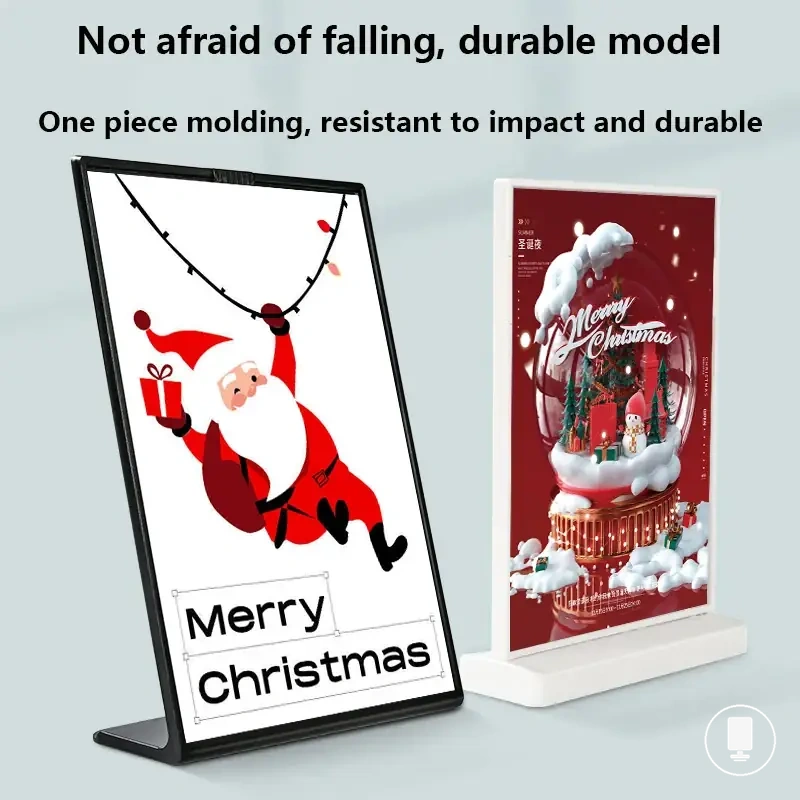
| Durable menu holder set | Supports repeated daily use and reduced replacement risk | Construction-focused designs may prioritize function over presentation style | Higher-use environments where durability is a key requirement |
An acrylic menu holder set is often compared through visibility, cleaning, and clear-display performance. A wooden menu holder set is usually compared through presentation, finish, and maintenance considerations. A durable menu holder set is typically compared through construction strength, daily use demands, and replacement risk.
Durability and presentation create different value outcomes depending on operating conditions. A durable set may justify its value when repeated handling increases wear concerns, while a wooden set may justify value when presentation is a stronger priority. An acrylic set may balance visibility and cleaning requirements when clear menu display is important.
The most suitable table menu holder set depends on which trade-offs match the intended use condition. Material, construction, cleaning requirements, presentation goals, and replacement risk should be evaluated together to choose menu holders confidently rather than relying on material type alone.
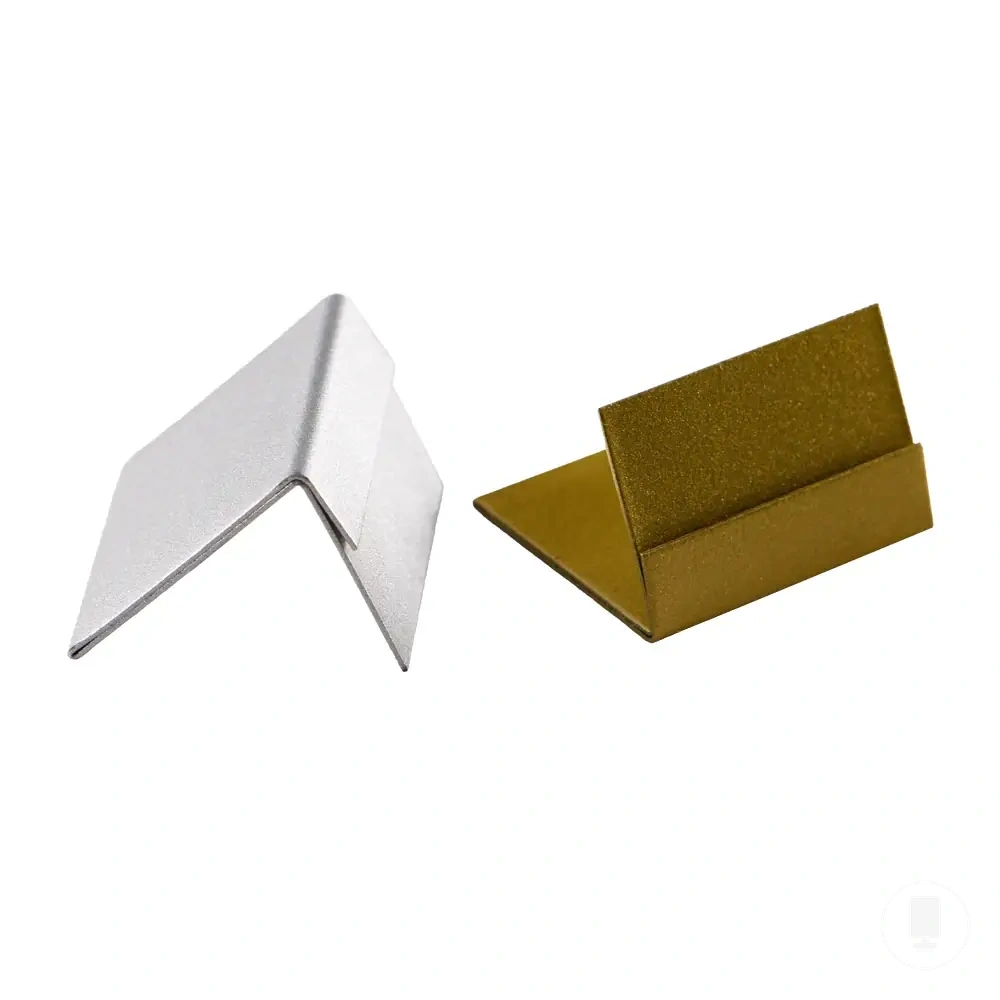
Here are product examples that may make comparison easier. Before buying, always review the compatibility criteria, essential features, and product details.
When a cheaper menu holder becomes lower value
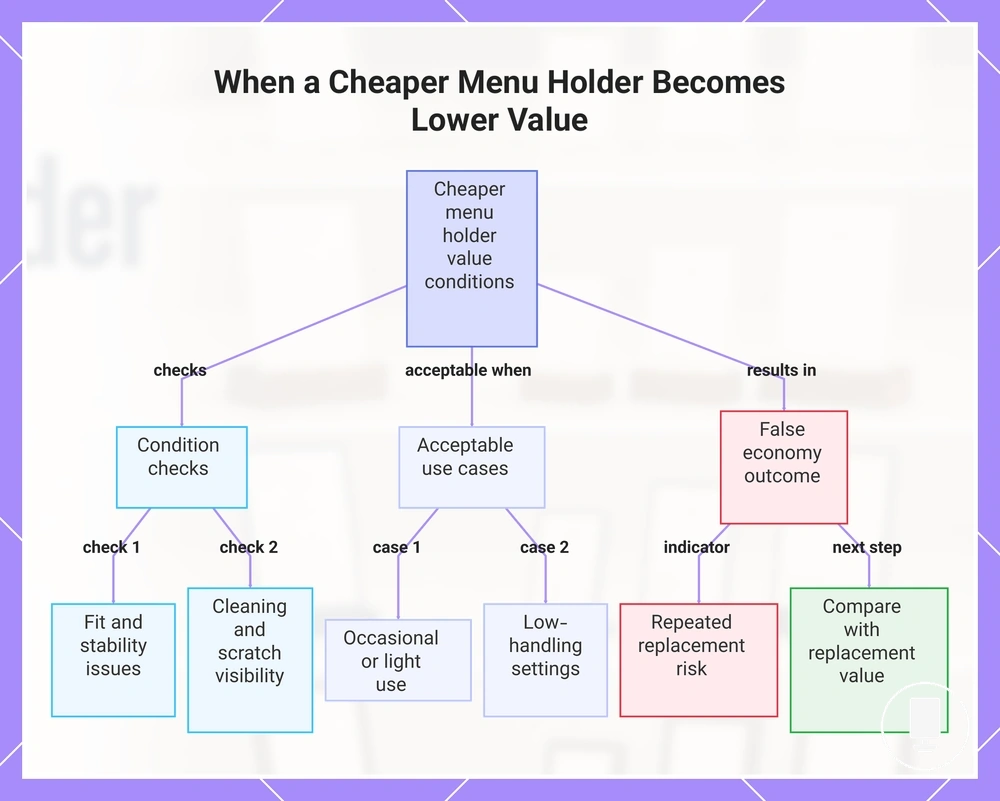
A cheaper menu holder becomes lower value when low price is offset by damage, poor fit, unstable display, or frequent replacement. A low-cost holder can still be reasonable when use is light, but value weakens when thin material, cleaning weakness, or insert mismatch affects usability and presentation.
When a cheaper menu holder becomes lower value, the main check is whether the holder can handle the use conditions without creating avoidable replacement risk. Use this checklist to verify fit, stability, cleaning, scratch visibility, and replacement frequency before judging price alone.
- Fit: Poor fit or insert mismatch can reduce usability when the menu insert does not sit securely or display clearly.
- Stability: An unstable display may create lower value when the base does not suit the table setting or handling level.
- Cleaning: Cleaning weakness can reduce value when frequent wiping affects appearance or makes upkeep harder.
- Scratch visibility: Scratch visibility may matter more when the holder is used in a visible table-service setting.
- Replacement frequency: Frequent replacement can turn a low price into false economy when damage or wear appears under normal use.
A cheaper menu holder may be acceptable for occasional use, short-term presentation, or low-handling settings where fit and stability are adequate. It becomes false economy when repeated replacement, unstable display, or poor fit costs more attention than the initial saving is worth. In that case, compare the low-cost option with when replacement is better value rather than treating purchase price as the only decision point.
This chart shows the main conditions that reduce value, acceptable use scenarios, and when a cheap holder becomes false economy.
Long-term value from durability, cleaning, and replacement timing
Long-term value depends on how upfront price relates to durability, cleaning frequency, wear resistance, and replacement timing over time. Total cost is influenced not only by the initial purchase but also by how often the holder is used, cleaned, updated, and eventually replaced under real use conditions.
| Use condition | Value pressure | What to monitor | Cost implication |
|---|---|---|---|
| Cleaning load | Frequent surface contact and upkeep | Cleaning frequency and surface condition | Higher cleaning demand can increase lifecycle cost over time |
| Visual wear | Appearance changes from daily use | Wear resistance and visible surface changes | Visual wear may affect ongoing value depending on presentation needs |
| Insert changes | Regular menu updates or revisions | Insert replacement frequency and holder condition | Frequent insert replacement can increase handling-related wear |
| Replacement timing | Changes in usability or appearance | Replacement timing and overall condition | Total cost may increase when replacement occurs more often than expected |
Cleaning frequency and wear resistance affect long-term value because daily use can accumulate maintenance effort and visible wear. Surface condition can signal whether a holder continues to meet presentation needs, while visual wear may become more noticeable in settings with higher table turnover. Durability affects how well the holder manages repeated handling and cleaning demands.
Replacement timing should be treated as a cost-value condition rather than a fixed schedule. Surface condition, insert replacement activity, and ongoing usability can help signal a replacement point, but the timing depends on use intensity and presentation expectations. A high-use table holder may justify greater attention to durability and wear resistance, while a lower-use display holder may maintain acceptable ongoing value under lighter conditions.
Value checklist for choosing menu holders
A value checklist for choosing menu holders depends on matching price to material, size, pack quantity, durability, cleaning, and replacement needs. Decision clarity improves when these criteria are evaluated together rather than through price alone.
- Price: Verify whether the price matches the expected level of use. The decision outcome may improve when cost aligns with practical requirements.
- Material: Match material to presentation goals and handling conditions. Material suitability can influence long-term value.
- Size: Verify that size supports menu format and display requirements. A better size match can improve usability and value.
- Pack quantity: Match pack quantity to table coverage and spare-unit needs. The decision outcome may weaken when excess units are unlikely to be used.
- Durability: Prioritize durability when handling frequency is higher. Durability can influence long-term cost through replacement needs.
- Cleaning: Verify that cleaning requirements fit daily operations. Easier upkeep may support ongoing value in higher-use environments.
- Replacement needs: Consider expected insert changes and holder replacement needs. Replacement activity can affect overall value over time.
- Use case fit: Match menu holders to the intended environment, usage level, and presentation requirements. Better fit often supports a clearer decision outcome.
The checklist works as a final verification step rather than a new comparison. Price, material, size, and pack quantity should be reviewed together because each criterion can affect value differently depending on coverage needs and usage patterns.
Durability, cleaning, and replacement needs are closely connected to long-term cost. A menu holder that matches expected handling conditions may provide stronger value than an option selected only for a lower upfront price.
Use case and budget help prioritize the checklist criteria. Higher-use environments may place greater importance on durability and cleaning, while lower-use settings may focus more on presentation fit, size, and pack quantity.
The final decision outcome comes from verifying that price, material, size, pack quantity, durability, cleaning, and replacement needs support the intended use of the menu holders. The value checklist helps confirm that each criterion contributes to practical value without adding unnecessary cost.
Here are product examples that may make comparison easier. Before buying, always review the compatibility criteria, essential features, and product details.
This chart groups the selection criteria into upfront factors, long-term cost factors, and prioritization factors to help evaluate menu holder value.