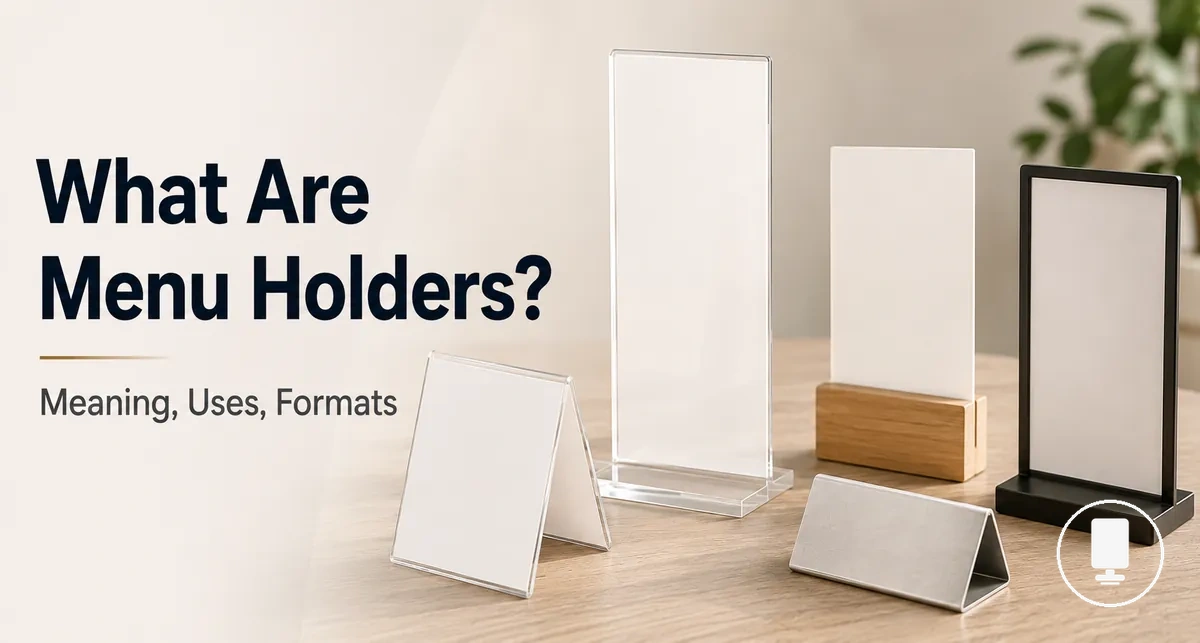
Menu Holders as Restaurant Menu Display Tools
Menu holders are display tools used to hold, support, or present printed menus and menu cards. They give printed menus a visible role in a restaurant, café, counter, or table display setting.
In a service setting, menu holders help keep printed menus upright, accessible, and easier to notice during ordering or browsing. Their role is practical rather than decorative only: they support menu visibility where customers need to read choices clearly.
Menu holders can appear in common formats such as a table menu holder, menu display stand, restaurant menu stand, or menu card holder. In everyday use, a menu holder, menu stand, and menu cover may overlap as names, but they can describe different physical formats.
The next section defines what a menu holder is before moving into uses, naming differences, and display formats.
What a Menu Holder Is
A menu holder is an item used to hold, support, or display a printed menu or menu card. It keeps menu information visible and accessible for viewing on a table or similar display surface. The basic function of a menu holder is to support menu presentation.
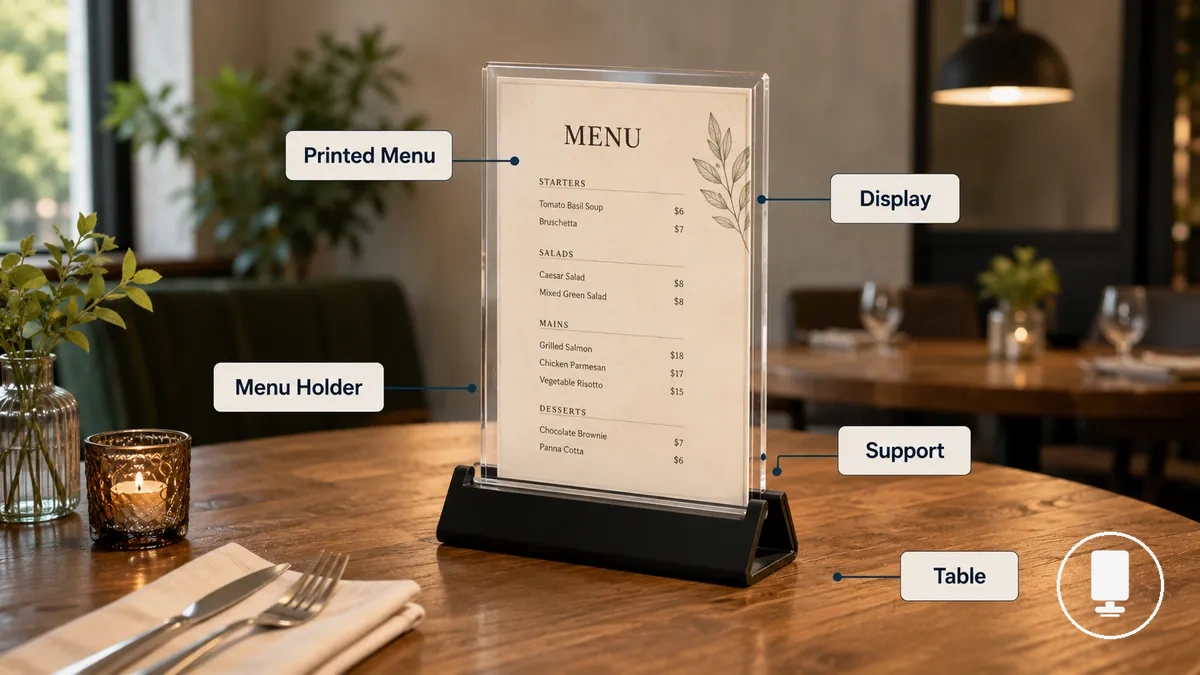
A menu holder provides physical support for a printed menu, menu card, or insert so the content remains visible in a restaurant setting. It can be placed on a table, countertop, or other tabletop display area where menu information needs clear presentation. The focus remains on holding and displaying the printed menu rather than the display structure itself.
The terms menu holder, menu display stand, restaurant menu stand, table menu holder, and menu card holder may overlap in everyday use because they describe related display functions. A menu display stand may emphasize upright presentation, while a menu holder more broadly refers to holding and supporting menu content. For a broader overview of related formats and uses, see the menu holders guide.
Menu Holder Meaning and Common Names
A menu holder is a display object used to support and present a printed menu or menu card. The meaning of menu holder centers on holding and displaying menu information in a visible position. Common names can overlap because similar display objects are used in related settings.
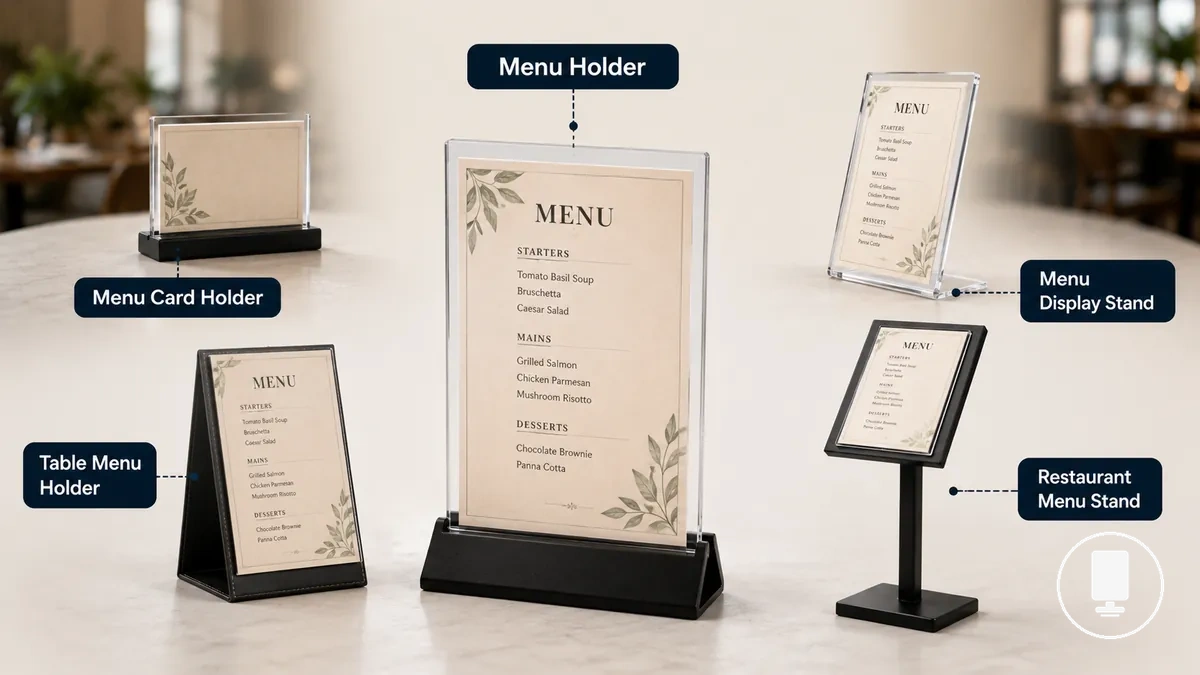
The same display object may be described with different names based on placement, shape, or use. These names often refer to related formats, but they may not describe exactly the same display holder in every context.
- Menu holder: A broad term for a holder that supports and displays a printed menu or menu card.
- Menu card holder: Often used for a holder designed to display a menu card or insert.
- Table menu holder: Usually refers to a holder placed on a table for tabletop presentation.
- Menu display stand: Commonly emphasizes upright display and visibility through a stand-style format.
- Restaurant menu stand: Typically describes a stand used in a restaurant setting, although the exact shape or support method may vary.
What Menu Holders Do for Printed Menus
Menu holders help keep printed menus visible, organized, and easier to read. They support menu presentation by holding menu information in a stable position on a table, counter, or service area. Their core function is to improve visibility, readability, and stability for printed menus.
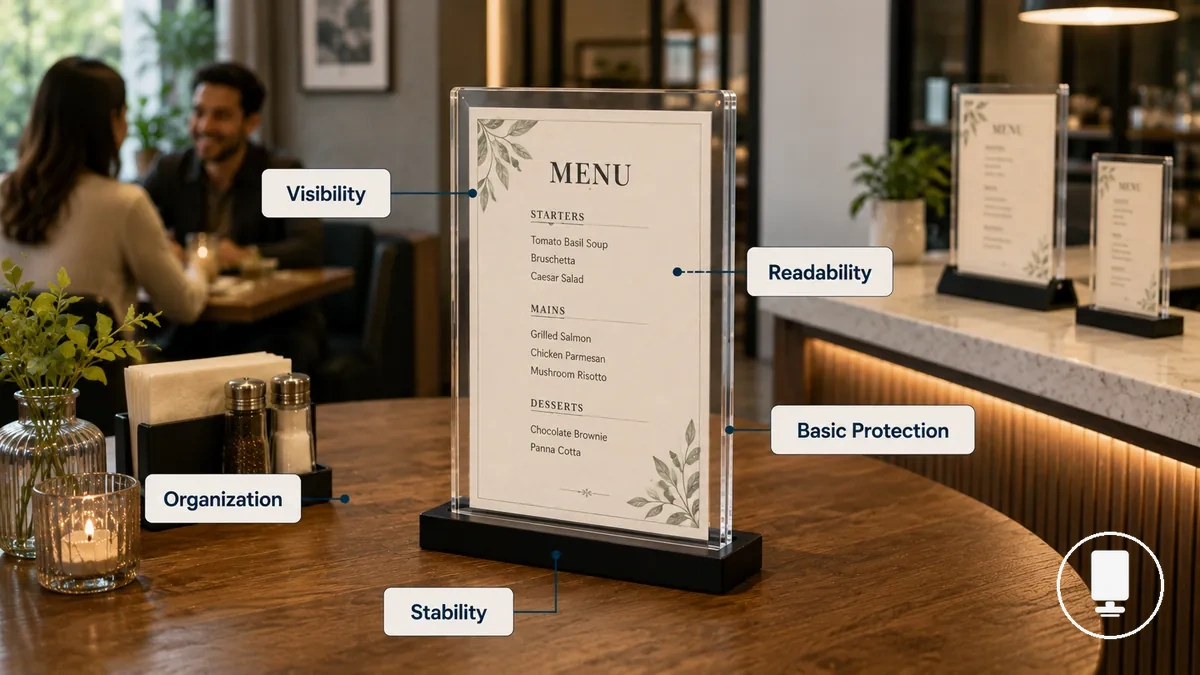
Menu holders can improve visibility by keeping printed menus positioned for easier viewing. They also support organization by giving menus a defined place on a table or display surface. In restaurant, café, counter-service, and table-service settings, a consistent viewing position can help maintain readability and a clearer customer view. The checklist below summarizes the main functions menu holders support.
- Visibility: Helps keep printed menus easier to see and view.
- Organization: Supports table order by giving menus a defined display location.
- Basic protection: May reduce direct handling or exposure depending on holder design and use conditions.
Menu holders also contribute to presentation by displaying menu information in a structured way. Basic protection can vary based on material, placement, handling, and holder design. In many cases, menu holders support clearer presentation while helping printed menus remain stable during normal use.
For more detailed display scenarios and placement considerations, see how menu holders are used.
Visibility, Organization, and Protection
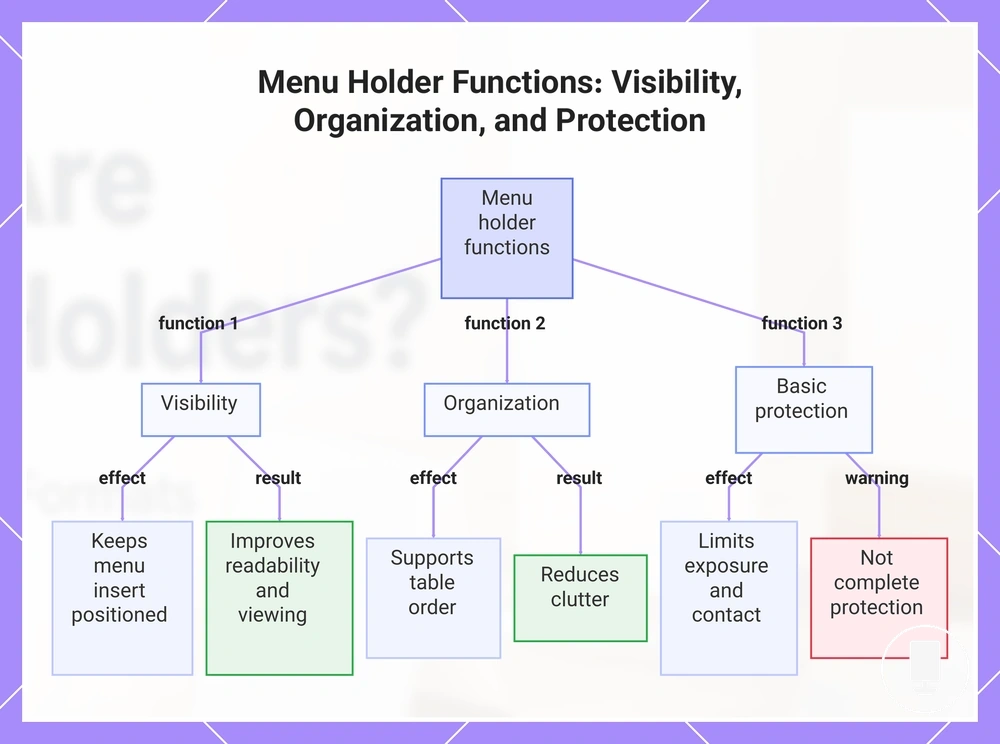
Menu holders support visibility by keeping a menu insert in a stable position that improves readability and viewing. A menu holder also supports table order by giving menu information a consistent place on the table instead of leaving it loose. These functions contribute to visibility, organization, and basic protection.
- Visibility: A menu holder keeps a menu insert positioned for clearer viewing and improved readability.
- Organization: A menu holder supports table order and can reduce clutter by keeping menu displays in a defined location.
- Basic protection: Holder design may reduce direct handling, contact, or exposure during normal use.
Basic protection depends on holder design, material, format, and handling conditions. A menu holder can help limit exposure and contact with a menu insert, but it should not be treated as complete protection. The level of protection varies by format and material and may help reduce wear in certain conditions.
This chart shows the three main functions of a menu holder and their key supporting details.
Branding and Presentation Support
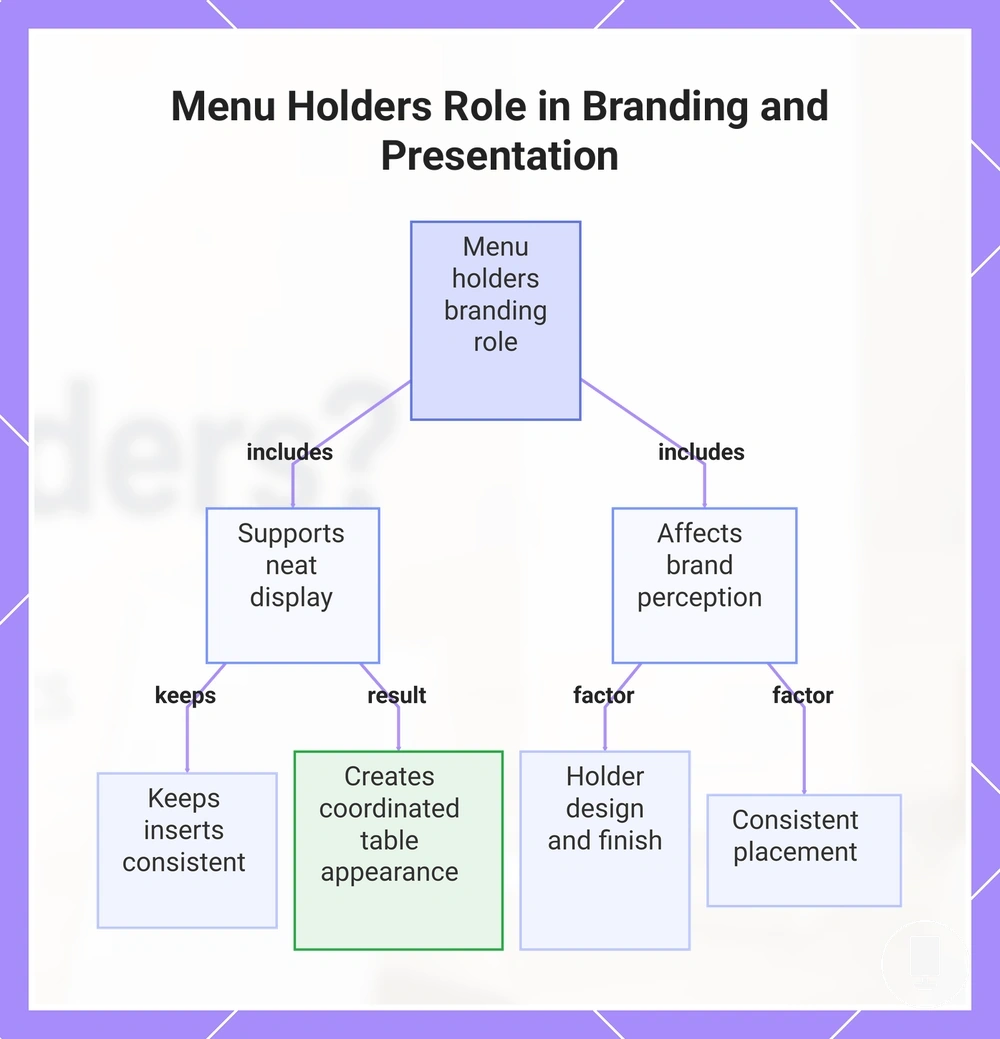
In a restaurant setting, menu holders can support branding and presentation by keeping menu inserts displayed in a neat and consistent manner. When visible inserts are positioned clearly and arranged consistently across tables or counters, the overall table appearance may appear more coordinated. This neat display can contribute to perceived presentation consistency.
Menu holders, holder design, and visible inserts can affect how menu presentation is perceived within a space. Placement, insert visibility, and finish may contribute to brand presentation and visual presentation, although the effect depends on the setting and context. For example, when the same menu holder style is used throughout a dining area, it may help create a more consistent table appearance while maintaining a clear menu display.
This chart shows how menu holders contribute to branding and presentation through neat display and key factors that influence perception.
Where Menu Holders Are Commonly Used
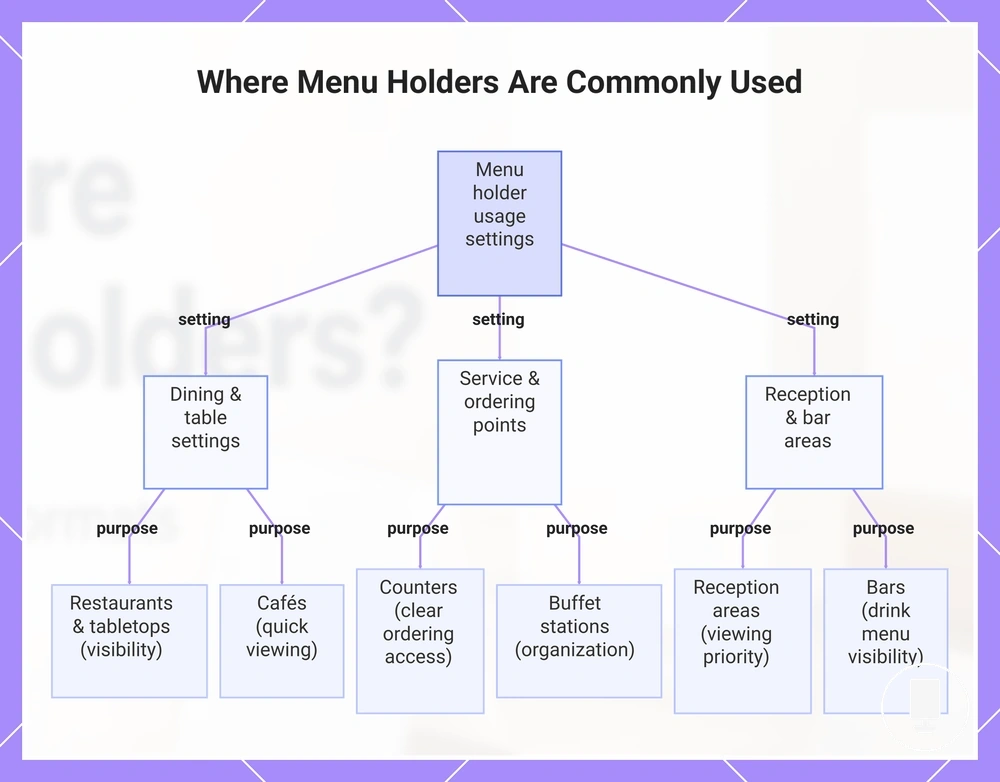
Menu holders are used across different service settings where printed menu information needs to remain visible, accessible, or organized. In each environment, the holder serves a different display need because location influences how people view and access information.
Restaurants, cafés, counters, and other display points use menu holders to support menu presentation in ways that fit the surrounding context. A menu holder may support visibility in one location, improve access in another, or contribute to organization where multiple printed items are displayed.
- Restaurants: Support menu visibility and access at dining tables and service areas.
- Cafés: Display menu cards in table settings or near counters where quick viewing is important.
- Counters: Present menu information in counter-service areas where customers need clear access during ordering.
- Reception Areas: Display printed information in a service setting where viewing and access are priorities.
- Buffet Stations: Support organization by presenting menu information, notices, or labels near food displays.
- Bars: Provide visibility and access for drink menus or menu inserts at seating and service areas.
- Tabletop Settings: Keep menu information available at the point of use while supporting visibility and organization.
This chart shows the common locations where menu holders are used and their primary purpose in each setting.
What Menu Holders Can Display Besides Main Menus
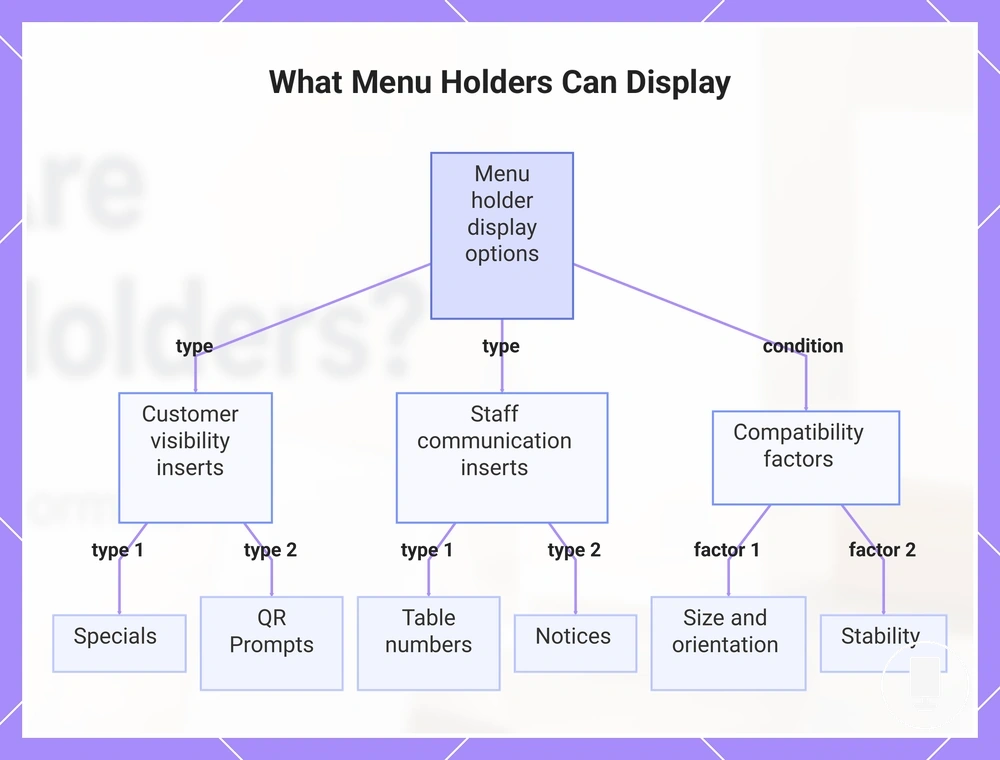
Menu holders can display more than main menus when the inserts fit the holder format and the printed material suits the intended display condition. In addition to menu cards, menu holders may hold different printed inserts that support customer visibility or staff communication. Whether a menu holder can display a specific insert depends on insert size, orientation, and holder format.
Size, orientation, and stability can affect whether a menu holder suits a particular insert. A holder that fits one type of printed material may not suit another format with different dimensions or display requirements. The examples below show common insert types that menu holders can display when the holder format and printed material are compatible.
- Specials: Present daily or limited-time menu items for customer visibility.
- Drinks Lists: Display beverage selections separately from main menus.
- QR Prompts: Communicate access points for digital menus or related information.
- Table Numbers: Help identify seating locations for staff communication and service organization.
- Offers: Display offer cards alongside menu information when the insert fits the holder.
- Notices: Present printed messages or table notices in a visible location.
- Dessert Cards: Show dessert options separately from main menus for easier viewing.
This chart shows the types of non-menu inserts that menu holders can display, grouped by purpose (customer visibility, staff communication) and the compatibility factors that affect fit.
Common Menu Holder Formats
Menu holder formats are physical display variations that affect how printed menus or menu cards are presented, viewed, and accessed. Format depends on placement, insert size, viewing angle, and display surface, making menu holder formats different ways to support menu visibility rather than a complete buying taxonomy.
Key format attributes include placement, insert capacity, orientation, and access method. These attributes influence how a holder fits a display condition and how easily users can view or reach the printed material. The table below outlines common menu holder formats and their display characteristics.
| Menu holder format | Placement | Insert capacity and orientation | Display condition or limitation |
|---|---|---|---|
| Table holder | Tabletop display surface | Usually supports menu cards or inserts positioned for close viewing | Suitable when visibility and access are needed at the table |
| Counter holder | Counter or service point | Can hold printed inserts for upright viewing | Supports quick access in counter-service settings |
| Wall-mounted holder | Wall display surface | Orientation depends on holder design and insert format | May improve distance visibility but access can depend on placement |
| Freestanding holder | Table, counter, or display surface | Insert capacity varies by holder format | Viewing angle and stability can affect suitability |
| Single-insert holder | Multiple display surfaces | Designed for one visible insert at a time | Fit depends on insert size and orientation |
For a broader explanation of display variations, see common menu holder types.
When evaluating format fit, compare holder attributes with menu sizes and inserts.
Table and Counter Menu Holders
Table menu holders and counter menu holders differ mainly in placement surface, viewing angle, and footprint. Table menu holders are commonly positioned for seated viewing, while counter menu holders are used for counter display where menu information needs to remain visible during ordering. This distinction separates table viewing from counter display within the same holder format category.
- Table menu holders: Use a tabletop placement surface and may support menu visibility during seated viewing. Footprint and viewing angle can influence how menu information is presented at the table.
- Counter menu holders: Use a service-counter placement surface and may support counter display during ordering. Viewing angle and footprint can affect how easily menu information is viewed from the counter area.
Suitability depends on the display condition, available space, and service context. Neither format represents a universal fit because placement surface, viewing angle, and footprint can influence how the holder is used.
Wall-mounted Menu Holders
Wall-mounted menu holders are a format used to display printed menus or notices on a wall display instead of on table surfaces. Wall-mounted menu holders position content at a fixed mounting position, while insert access and viewing distance can influence how easily printed information is viewed. For example, a wall display holder may present a printed notice near an entrance or service area where visibility is needed away from tabletops, making it a format that can support visibility and space saving within a specific placement context.
Menu Card and Insert Holders
Menu card holders and insert holders are formats designed to hold smaller or replaceable printed pieces rather than larger menu formats. These holder formats support printed cards that need clear presentation while allowing replaceability when menu information changes. Their purpose is to provide fit and visibility for smaller replaceable pieces.
Card size, insert size, orientation, replaceability, and viewing side can affect how a printed piece fits within a holder format. Insert fit depends on dimensions and orientation, so suitability may vary between different printed cards and menu insert holders. For deeper clarification about dimensions and fit considerations, see menu sizes and inserts.
- Menu cards
- Special offer inserts
- Printed notices
Menu Holder, Menu Stand, and Menu Cover Differences
A menu holder, menu stand, and menu cover differ mainly in function, support method, enclosure, and display style. A menu holder focuses on supporting and displaying a printed menu, a menu stand emphasizes upright support for visibility, and a menu cover focuses on enclosing and presenting menu pages. The terms can be confusing because names often overlap across physical formats.
The comparison below organizes these terms by function and physical behavior rather than as a product ranking or selection guide. Comparing support method, enclosure, and display style helps clarify how each format is commonly described.
| Term | Function | Support Method | Enclosure | Display Style |
|---|---|---|---|---|
| Menu holder | Supports and displays a printed menu | Holds a menu in a visible position | Usually limited or partial enclosure | Menu display on a table, counter, or display surface |
| Menu stand | Provides upright support for menu presentation | Uses a stand structure for display | May have little or no enclosure | Emphasizes upright visibility and presentation |
| Menu cover | Contains and presents menu pages | Supports menus through a cover format | Typically encloses or contains pages | Focuses on page presentation and organization |
Some physical formats combine functions, so a single item may be described as a menu holder, menu stand, or menu cover depending on its design and use. The name alone may not identify the exact physical format.
When a Basic Menu Holder Is Enough
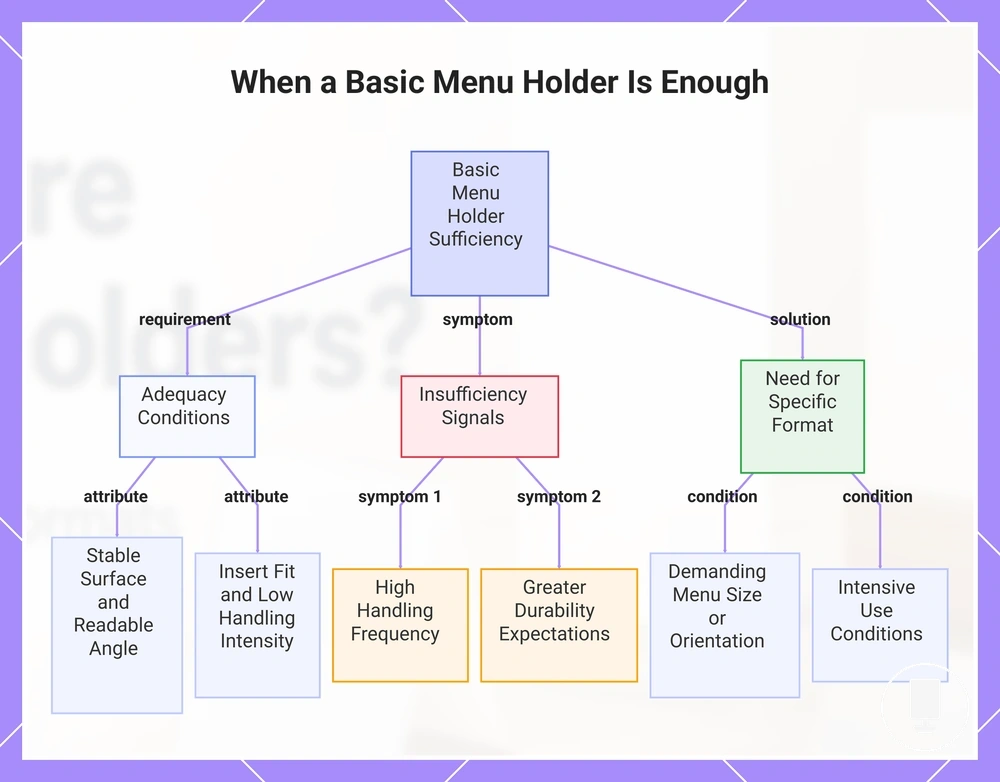
A basic menu holder is enough when the display need depends on menu size, placement, handling frequency, and durability expectations. A basic menu holder can support clear presentation when it sits on a stable surface, provides a readable angle, and maintains suitable insert fit. These are the core adequacy conditions for a simple holder.
Insert fit depends on menu size, orientation, and holder condition rather than on the holder name alone. A stable surface can help keep menu information visible, while a readable angle can improve viewing in normal use. Simple cleaning may be sufficient when menus are handled occasionally and replaced without frequent disruption. As handling frequency and durability expectations increase, a more specific format may be needed.
The checklist below summarizes common decision signals.
- Enough: The basic menu holder uses a stable surface, provides a readable angle, supports insert fit, allows simple cleaning, and experiences low handling intensity.
- May not be enough: Handling frequency is high, inserts are replaced often, or durability expectations are greater than the holder format may support.
- May need a more specific format: A stronger holder, larger holder, covered holder, or other specific format may be more suitable when menu size, orientation, or use conditions become more demanding.
For broader context about menu display formats and usage conditions, see the menu holders guide.
When display needs extend beyond basic support and presentation, reviewing common menu holder types can help clarify which specific format aligns with the intended condition.
This chart shows the conditions under which a basic menu holder is sufficient, the signals that indicate it may not be enough, and when a more specific format is needed.